
Eve Sonneman (b. 1946) has spent her working life on a fascinating narrative conundrum, how two frames placed side by side forge a collective story that neither contains. From the late 1960s, she began pairing two exposures of the same scene, made seconds apart and inches from one another, so that the interval between them, rather than the moment captured in either, becomes the subject. Her photography responds, in her words, to “a tiny moment of gesture or innuendo and of change,” and the gap between the frames demands interpretation in much the same way that a film is understood as a succession of events rather than a sequence of still images.
Born in Chicago in 1946 and raised in Texas, Sonneman received a BFA in painting from the University of Illinois in 1967 and an MFA in photography from the University of New Mexico in 1969, where she began making her diptychs. She moved to New York that year, and her career was launched with Young Photographers at The Museum of Modern Art in 1971.
Her early pairs are black and white, printed to reveal the sprocket holes of the negative, allowing the two frames to read as consecutive exposures on a single strip of film. The Smoker, Chinatown, New York (1972) places a man raising a cigarette to his mouth beside the same man lowering it; the entire passage of time contained within the work is the duration of a single breath. Real Time, 1968–1974, published by Printed Matter in 1976, brought this early body of work together.
Sonneman worked exclusively in black and white until 1974, when she began to engage with the contested transition to color. Her Coney Island series introduced a more cinematic approach, pairing a black-and-white frame with a chromogenic one and progressively shortening the interval between them. By the early 1980s, she was making large single Cibachromes that folded two temporalities into a single image: bathers at Coney Island as a roller coaster burns behind them; dancers in Brooklyn moving in ritual time while a traffic light marks the pace of ordinary time. Her later work employs digital color processes to examine human interaction and the changing forms of social communication.
Sonneman has also maintained a parallel practice in painting, producing large-scale abstractions, watercolors and painted objects, as well as sculpture and installation. She was represented by a leading New York gallery for fourteen years. Her work was included in Documenta in 1977 and has been presented at the biennales of Venice, Paris, Strasbourg and Sydney. She has published five books and has been the subject of some seventy-seven solo exhibitions. Bruce Silverstein Gallery has presented her work in In Sequence (2025).
-
 Eve SonnemanCatherine Slip, Chinatown, NYC, 1971Gelatin silver print, printed c. 19714 1/2 x 13 1/4 in (11.4 x 33.7 cm)
-
Eve SonnemanPushing, Houston, 1971Gelatin silver print, printed c. 19714 5/8 x 13 3/8 in (11.8 x 34 cm)
-
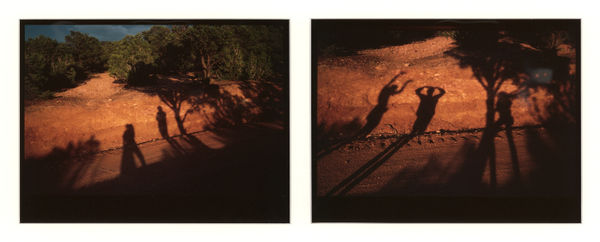
Eve SonnemanShadows, Santa Fe, New Mexico, 1978Two cibachrome photographs21 x 31 in (53.34 x 78.74 cm)
-
Eve SonnemanThe Land/The Moon, Rio Pecos, New Mexico, 1978Two cibachrome color photographs21 x 30 3/4 in (53.34 x 78.11 cm)
Each 7 1/4 x 9 1/2 in -
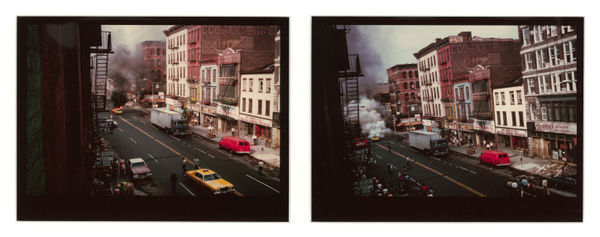
Eve SonnemanBowery Fire, 1980Cibachrome print, printed c. 19808 x 9 7/8 in (20.3 x 25.1 cm)





-
In Sequence
26 Jun - 29 Aug 2025 Gallery ExhibitionsBruce Silverstein Gallery is pleased to present In Sequence , a group exhibition that brings together the works of Adger Cowans, Elger Esser, Todd Hido, Dakota Mace, Barbara Morgan, Ed...Read more -
TOPOGRAPHICS
PHOTOGRAPHS FROM 1844 TO THE PRESENT 2 Oct - 13 Nov 2004 Gallery ExhibitionsRead more -
Eve Sonneman
Diptychs 22 Mar - 11 May 2002 Gallery ExhibitionsRead more


