
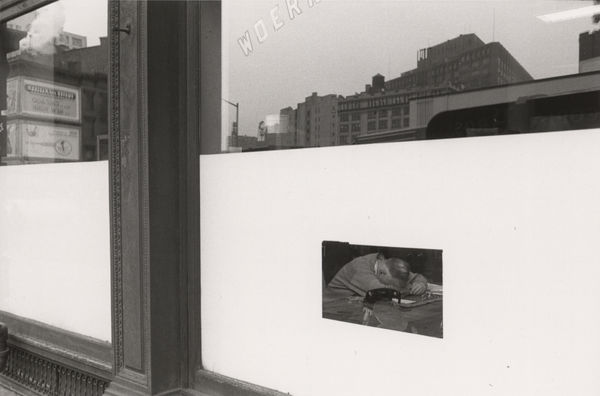
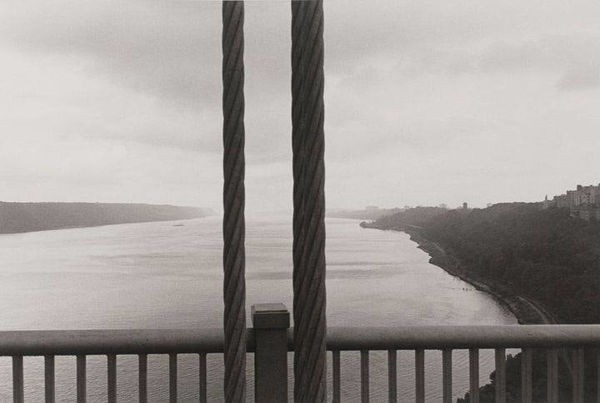
Lee Friedlander (b. 1934) has spent seven decades making photographs that insist on the flatness of the picture plane. Where most photographers treat the frame as a window onto the world, Friedlander treats it as a surface to be filled, layering reflections, views through glass and objects within it until they occupy the same visual field. A shop window holds the street reflected across its surface alongside the goods displayed within; a car window, a side mirror and a boulevard receding to the horizon collapse into a single image. Ambiguity is the subject. His own shadow appears throughout the street photographs, and his reflection in countless windows, placing the photographer inside the picture and exposing the photograph as an image constructed from the world rather than simply extracted from it.
Born in Aberdeen, Washington, in 1934, Friedlander began photographing in 1948, driven by what he has described as a fascination with the equipment itself. He attended the Art Center School in Los Angeles to train as a professional photographer but left before completing his studies. Moving to New York in 1956, he worked as a freelance photographer, making portraits of musicians for record covers. In pursuit of magazine assignments, he encountered the work of photographers who would become important reference points for his own: Robert Frank, Diane Arbus, Garry Winogrand, Louis Faurer, Helen Levitt, Richard Avedon and Walker Evans.
Friedlander’s bodies of work have accumulated over decades with a methodical consistency. They include his expansive record of the American social landscape in the 1960s; his self-portraits; and The American Monument, in which thousands of plaques and statues appear absorbed into the everyday landscapes that have grown up around them. He went on to photograph nudes, desert plants, working people, his family, and the streets of Ohio and New York City. He is also responsible for bringing the work of E. J. Bellocq to wider attention, having acquired and printed Bellocq’s glass negatives depicting the women of Storyville.
In 1967, John Szarkowski included Friedlander in New Documents at The Museum of Modern Art, alongside Diane Arbus and Garry Winogrand. The exhibition gave a name to an emerging approach to documentary photography and helped define the terms of the medium’s development over the following two decades. Friedlander’s books have appeared with remarkable regularity, among them Self Portrait (1970), The American Monument (1976), Like a One-Eyed Cat (1989), Nudes (1991), The Desert Seen (1996), and Sticks and Stones and Family (2004). For years he worked with a Leica before moving to a wide-angle medium-format camera, whose squarer frame allowed him to compress the visual field even further.
Friedlander has received Guggenheim Fellowships and a fellowship from the National Endowment for the Arts, followed by a MacArthur Fellowship in 1990 and the Hasselblad Award in 2005. That same year, The Museum of Modern Art presented Friedlander, a comprehensive retrospective of his work.
Friedlander’s work was included in Bruce Silverstein Gallery’s DISCOVERIES (2010).
-
 Lee FriedlanderNew York City, 1964Gelatin silver print, printed c. 1960s - 1970s7 1/4 x 11 in (18.4 x 27.9 cm)
-
Lee FriedlanderGeorge Washington Bridge, 1973Gelatin silver print, printed c. 1970s7 1/4 x 11 in (18.4 x 27.9 cm)

-

Paris Photo 2026
11 - 15 Nov 2026Opening Wednesday, November 11, 2026 (by invitation only) Collectors Circle: 11 a.m. – 9 p.m. VIP: 2pm – 9pm Early Access Collectors Circle & VIP...Read more -

AIPAD 2025
23 - 27 Apr 2025Read more -

AIPAD 2023
30 Mar - 2 Apr 2023Read more -

PARIS PHOTO 2019
7 - 10 Nov 2019Bruce Silverstein Gallery is pleased to present an exhibition that will include both iconic and lesser known photographs by some of the most important photographic...Read more -

AIPAD 2019
4 - 7 Apr 2019Read more -

ART BASEL 2016
16 - 19 Jun 2016Read more -

AIPAD 2016
14 - 17 Apr 2016At the 2016 AIPAD Photography Show, Bruce Silverstein Gallery is proud to present Triumph of the Egg, featuring works of the same title by two...Read more -

PARIS PHOTO 2015
12 - 15 Nov 2015Read more -

FRIEZE MASTERS 2015
14 Oct 2014 - 18 Oct 2015The gallery is pleased to present a selection of modern photographic masterpieces at Frieze Masters in London from October 14 to 18, 2015. Artists include...Read more