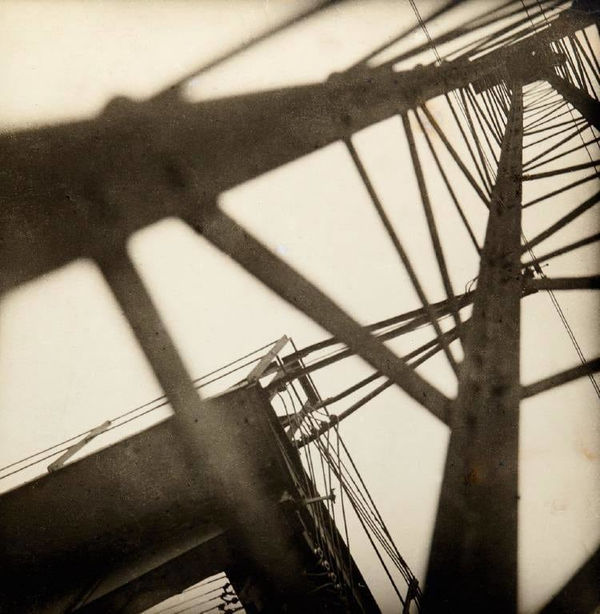
Jaroslav Rössler (1902–1990) was one of the most distinctive artists of the Czech avant-garde and, alongside Jaromír Funke, a central figure in Czech Constructivist photography. Bringing together elements of Symbolism, Pictorialism, Expressionism, Cubism, Futurism, Constructivism, and New Objectivity, he developed a singular visual language in which subjects were reduced to elementary lines and shapes, producing images that proposed a new reality rather than recording an existing one.
Born in Smilov to a Czech-German father and a Czech mother, Rössler left school at fifteen and entered the Prague studio of František Drtikol and Augustin Škarda in 1917 as an apprentice. He qualified in 1920 and remained as a laboratory technician until 1925, though he had almost immediately departed from his teacher’s Pictorialist approach.
At twenty-one, Rössler began working with the theorist Karel Teige, who commissioned him to design typographic layouts for the magazines Pásmo, Disk, Stavba, and ReD. This work deepened his engagement with the formal possibilities of photography. By the early 1920s, he was producing some of the earliest Czech photograms, alongside abstractions built from cones, spheres, and geometric paper cut-outs illuminated against black. Made in the first half of the decade, these works rank among the earliest and most radical applications of abstract and Constructivist principles to photography internationally. In 1923, he was invited to join Devětsil, becoming the group’s only photographer.
Reduction was central to Rössler’s method. He photographed simple objects against stark backgrounds, used long exposures to create hazy cones and spheres of light, and experimented with enlarged details, diagonal compositions, photomontage, carbon printing, and double exposure. His prints range from subtle tonal greys to strikingly high contrasts, distorting lines and shapes and, at times, incorporating color. He photographed modern engineering and architecture from Constructivist angles and produced color advertising photographs and still lifes using the carbro process, an unusual technique for the period. From 1926, he also photographed productions for Prague’s Liberated Theatre and worked for the illustrated weekly Pestrý týden.
A six-month stay in Paris in 1925 led to a permanent move at the end of 1927 with his wife, Gertruda Fischerová, who had also trained under Drtikol. Rössler worked in the commercial studios of Manuel Frères and Lucien Lorelle, later Studio Piaz, until 1935. His photographs from this period include a study of the Eiffel Tower’s construction in 1928. During the 1930s, he photographed Paris street life and became involved in protest and political activism. In 1935, he was expelled from the city for participating in street demonstrations. Returning to Prague, he opened a studio specializing in commercial and utilitarian work, which he continued to operate even after the nationalization of the economy, before largely abandoning photography.
After two decades of limited photographic activity, Rössler returned to serious work in the late 1950s. He engaged with the concerns of Czech Informel and developed a more systematic approach to solarization. His work re-emerged publicly in 1961 in the Prague quarterly Revue Fotografie and in 1966 at the exhibition Surrealism and Photography in Brno, where he showed alongside photographers a generation younger than himself. Rössler died in Prague in 1990, with much of his work still unpublished. A monograph did not appear until Vladimír Birgus and Jan Mlčoch published their studies in 2001 and 2003; the latter was issued in English by MIT Press, with essays by Karel Srp and Matthew Witkovsky.
-
 Jaroslav Rossler‘Konstrukce’ (Eiffel Tower), 1928Gelatin silver print, printed c. 19288 3/4 x 8 5/8 in (22.2 x 21.9 cm)