
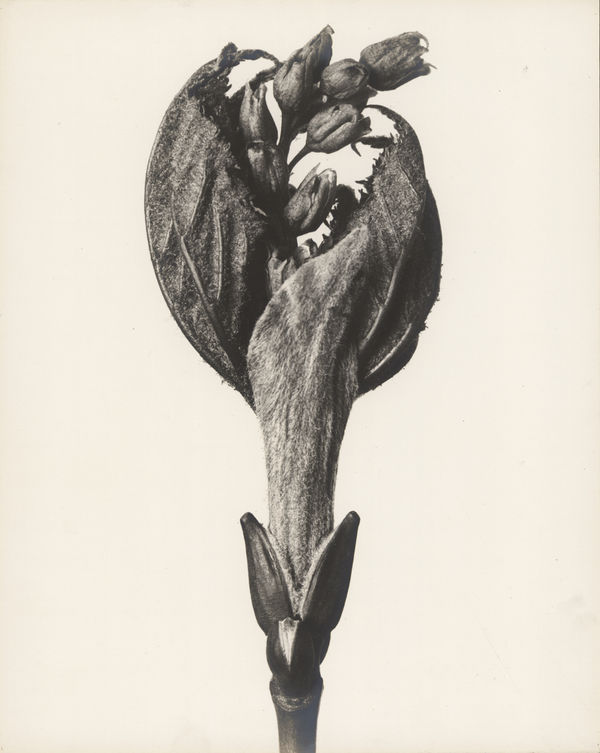
Karl Blossfeldt (1865–1932) spent three decades photographing plants as teaching aids and, in the process, created one of the foundational bodies of modern photography. Using a camera of his own construction, capable of magnifying his subjects up to thirty times, he isolated buds, stems, seed heads and unfurling ferns against plain grey backgrounds, photographing them frontally in natural light. The resulting images evoke architecture, ironwork and carved ornament as readily as botanical specimens. What Blossfeldt conceived as visual evidence for a theory of design came to be recognized as art in its own right. His photographs have profoundly influenced how subsequent generations of photographers look at the natural world. Alongside August Sander and Albert Renger-Patzsch, he is regarded as a defining figure of Neue Sachlichkeit, or New Objectivity, the movement that emerged in Germany in the 1920s. The Metropolitan Museum of Art identifies these three photographers as central precedents for Bernd and Hilla Becher, whose work began in 1959.
Blossfeldt initially trained as a sculptor and modeler. In 1881, at the age of sixteen, he became an apprentice iron caster at the art foundry in Mägdesprung, in the Harz Mountains. Three years later, he moved to Berlin to study drawing at the teaching institute of the Royal Arts and Crafts Museum. In 1890, a scholarship took him to Rome as an assistant to Moritz Meurer, professor of ornament. Over the next six years, he made and photographed casts of botanical specimens, travelling to Greece and North Africa to collect plant material. It was during this period that he developed the method he would follow throughout his life: a single specimen, isolated against a neutral ground and photographed in a frontal, almost taxonomic view.
Returning to Berlin, Blossfeldt began teaching at the Unterrichtsanstalt of the Royal Arts and Crafts Museum in 1898, remaining there until 1930 and becoming a full professor in 1921. His photographs were made primarily for his students, serving a pedagogical purpose grounded in his conviction that the fundamental forms of art already existed in nature. For three decades, he continued to expand the series, ultimately accumulating more than six thousand negatives. He published very little of this work and exhibited it even less frequently.
It was the Berlin dealer Karl Nierendorf who recognized the photographs’ artistic significance. In 1926, he exhibited them alongside sculpture from Papua New Guinea and paintings by Richard Janthur. The publication of Urformen der Kunst in 1928 brought Blossfeldt international recognition at the age of sixty-three. Its 120 plates, drawn from three decades of work, presented plant forms with a clarity and formal intensity that resonated with the Neue Sachlichkeit’s emphasis on precise, unsentimental description. Blossfeldt’s photographs appeared to offer nature itself, without artistic intervention, even as their framing and magnification revealed unexpected abstractions. That same year, Walter Benjamin reviewed the book in his essay News about Flowers.
Wundergarten der Natur followed in 1932, and Wunder in der Natur was published posthumously in 1942. Blossfeldt died in Berlin on 9 December 1932. Today, the Karl Blossfeldt Archive is held by the Ann and Jürgen Wilde Foundation, incorporated since 2010 into the Bayerische Staatsgemäldesammlungen and based at Munich’s Pinakothek der Moderne. The Universität der Künste Berlin preserves the working collection associated with his teaching. His systematic studies of natural form established a visual language that would find a direct successor in the typologies of Bernd and Hilla Becher and, through their influence, in much of photography that followed.
Blossfeldt’s work was presented at Bruce Silverstein Gallery in Photographer as Sculptor, Sculptor as Photographer (2025).
-
 Karl BlossfeldtAcer pensylvanicum (Striped maple), 1915 - 1925Gelatin silver print, printed c. 1915 - 192511 3/4 x 9 3/8 in (29.7 x 23.8 cm)
-
Karl BlossfeldtCentaurea kotschyana, 1915-1925Gelatin silver print, printed c. 1915-192511 7/8 x 9 3/8 in (30.3 x 23.8 cm)
-
Karl BlossfeldtAnemone, Pulsatilla, 1920Gelatin silver print, printed c. 192022 1/2 x 11 1/4 in (57.1 x 28.6 cm)


-
Photographer as Sculptor, Sculptor as Photographer
Rosario Ana Vizoli, Meer, June 10, 2025 -
Photographer as Sculptor, Sculptor as Photographer @ Bruce Silverstein
Just the FactsLoring Knoblauch , Collector Daily , May 30, 2025 -
Photographer as Sculptor, Sculptor as Photographer
ReviewGreer Valaquenta, Musée Magazine, May 1, 2025 -
Exhibition at Bruce Silverstein's new space explores the fascinating intersection on photography and sculpture
Art Daily, April 10, 2025 -
Bruce Silverstein Gallery: Photographer as Sculptor, Sculptor as Photographer
The Eye of Photography, April 7, 2025 -
Photographer as Sculptor, Sculptor as Photographer
Meer, March 12, 2025


-

AIPAD 2026
23 - 26 Apr 2026BOOTH B01 For hours and events, visit AIPAD . Thursday, 4pm - Chester Higgins will be in our booth to talk about his photography. Friday,...Read more -

PARIS PHOTO 2023
5 Nov 2023 - 10 Feb 2024In a profound celebration of indigenous art and heritage, Bruce Silverstein Gallery is proud to present the works of two remarkable Native American artists, Sarah...Read more -

AIPAD 2023
30 Mar - 2 Apr 2023Read more -

AIPAD 2022
20 - 22 May 2022Read more -

Frieze Masters 2014
15 - 19 Oct 2014For Frieze Masters 2014 Bruce Silverstein Gallery proposes a solo exhibition of the work of Keith Smith, an American artist active in the 1960s-80s. This...Read more -

ART BASEL 2014
17 - 22 Jun 2014For Art Basel 45 Bruce Silverstein Gallery would be pleased to present an exhibition featuring rare, vintage prints by André Kertész created during his years...Read more -

AIPAD 2014
10 - 13 Apr 2014Read more -

THE ARMORY SHOW 2014
6 - 9 Mar 2014For The Armory Show 2014 Bruce Silverstein Gallery proposes an exhibition featuring the work of the artist Shinichi Maruyama. Over the past decade, Maruyama’s work...Read more