
Walker Evans (1903–1975) was among the most influential American photographers of the twentieth century, whose unsentimental yet deeply perceptive images fundamentally transformed documentary photography. His photographs of ordinary American life—from roadside stands, storefronts, and vernacular architecture to tenant farmers' homes and anonymous subway passengers—redefined what was considered worthy of photographic attention. His work profoundly influenced subsequent generations, including Robert Frank, Diane Arbus, and Lee Friedlander. Rejecting conventional notions of artistic expression, Evans described his approach as "documentary style," producing images distinguished by their clarity, restraint, and quiet authority. John Szarkowski, who organized Evans's 1971 retrospective at The Museum of Modern Art, credited him with transforming how Americans perceived their familiar surroundings.
Born in St. Louis, Missouri, and raised in Toledo, Ohio, Evans attended Williams College briefly before traveling to Paris in 1926, initially aspiring to become a writer. Returning to New York in 1927, he turned to photography, bringing a literary sensibility that would remain central to his work. By 1930, he had rejected the soft-focus aesthetics of Pictorialism in favor of a direct, restrained visual language influenced by Eugène Atget's documentation of Paris. In 1935, Evans began working for the Resettlement Administration, later incorporated into the Farm Security Administration (FSA), traveling through the American South with an 8-by-10-inch view camera. In 1936, he took leave to collaborate with writer James Agee on a Fortune magazine assignment documenting tenant cotton farmers in Hale County, Alabama. Although initially rejected by the magazine, the project was published in 1941 as Let Us Now Praise Famous Men, a landmark of twentieth-century documentary photography and literature. Evans's portraits of the Burroughs family remain among the most enduring images of the Great Depression.
In 1938, The Museum of Modern Art presented Walker Evans: American Photographs, its first solo exhibition devoted to a photographer. The accompanying book, featuring an essay by Lincoln Kirstein, established a new standard for the photographic monograph through its sophisticated selection and sequencing of images. That same year, Evans began secretly photographing passengers on the New York City subway using a concealed Contax camera. Continuing through 1941, the project captured unsuspecting subjects in moments of unguarded contemplation, producing an intimate portrait of urban life. Published in 1966 as Many Are Called, the photographs reveal what Evans described as moments when "the guard is down and the mask is off."
From 1945 to 1965, Evans worked as a staff photographer and later an editor at Fortune, producing photographic essays that he often conceived, wrote, and designed himself. Among these was Beauties of the Common Tool, celebrating the sculptural elegance of ordinary industrial objects. His work for the magazine extended his exploration of American material culture and the visual poetry of the everyday. Appointed professor of graphic design at Yale University in 1965, Evans taught until 1974, influencing a new generation of artists and photographers. In his final years, he embraced the Polaroid SX-70, producing intimate studies of signs, objects, and vernacular details that demonstrated the enduring consistency of his vision across changing technologies. Evans died in New Haven, Connecticut, in 1975.
Bruce Silverstein Gallery has presented Evans's work in TOPOGRAPHICS (2004) and An Outsider's Eye (2024).
-
 Walker EvansWorkmen Eating Lunch, 1928Gelatin silver print, printed c. 19289 x 5 7/8 in (22.9 x 14.9 cm)
-
Walker EvansWare, Massachusetts, 1932Gelatin silver print mounted to board, printed c. 19324 1/2 x 6 1/2 in (11.4 x 16.5 cm)
Mount: 6 x 7 1/2 in -
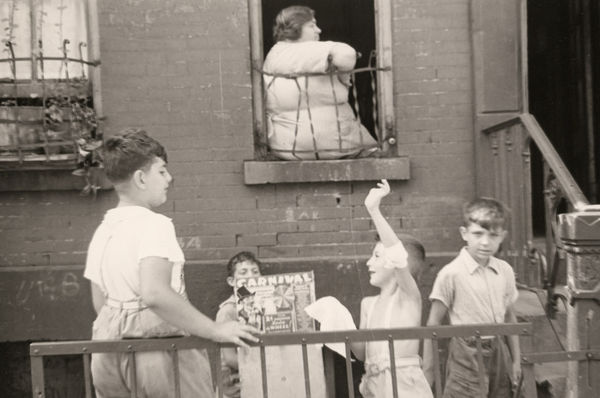
Walker EvansUntitled, Boys with woman in window, 1935Gelatin silver print, printed c. 19606 1/4 x 9 1/2 in (15.9 x 24.1 cm)
-
Walker EvansSausage Sign, 1936Gelatin silver print, printed c. 19366 x 8 in (15.2 x 20.3 cm)
-
Walker EvansFlood Refugees, Forrest City, Arkansas, February, 1937Gelatin silver print, printed c. 19377 5/8 x 8 5/8 in (19.4 x 21.9 cm)
-
Walker EvansUntitled, 1940sGelatin silver print, printed c. 1940s8 3/8 x 10 1/8 in (21.3 x 25.7 cm)
-
Walker EvansBedroom, Shrimp Fisherman's House, Biloxi Mississippi, 1945Gelatin Silver Print, printed c. 19457 1/2 x 9 1/2 in (19.05 x 24.13 cm)
-
Walker EvansChrist or Chaos, 1946Gelatin silver print, printed c. 1946
Harry Lunn stamp on verso14 x 11 in (35.6 x 27.9 cm) -
Walker EvansGrosvenor Gate, London, June 10, 1955Gelatin silver print, printed c. 19558 x 10 in. (20.32 x 25.4 cm.)
-
Walker EvansUntitled, Buildings with crane, 1960Gelatin silver print, printed c. 19609 x 10 1/2 in (22.9 x 26.7 cm)
-
Walker EvansUntitled, Iron bench, 1960Gelatin silver print; printed c. 19606 1/2 x 8 1/2 in (16.5 x 21.6 cm)
-
Walker EvansThird Avenue, New York City, 1962Gelatin silver print, printed c. 196214 x 11 in. (35.56 x 27.94 cm.)
-
Walker EvansUntitled, 1963Gelatin silver print, printed c. 19638 x 10 in (20.3 x 25.4 cm)
-
Walker EvansTrain Tracks and Cobblestone Road, New York City, c. 1929Gelatin silver print, likely printed c. 1950s5 1/4 x 8 1/4 in. (13.3 x 21.0 cm.)
-
Walker EvansUntitled, Tahiti, c. 1935Gelatin silver print, printed c. 19608 x 6 1/2 in (20.32 x 16.51 cm)
-
Walker EvansUntitled, n.d.Gelatin silver print, printed c. 1960s8 x 10 in (20.32 x 25.4 cm)




-
An Outsider's Eye
Discoveries from Bruce Silverstein Gallery, Curated by Frank Maresca 18 Apr - 18 May 2024 Outside ExhibitionsAn Outsider's Eye features more than 20 artists, including Karl Blossfeldt, Edward Weston, Man Ray, André Kertész, Dorothea Lange, Paul Outerbridge, Lisette Model, Walker Evans, Aaron Siskind, Bill Cunningham, and...Read more -
TOPOGRAPHICS
PHOTOGRAPHS FROM 1844 TO THE PRESENT 2 Oct - 13 Nov 2004 Gallery ExhibitionsRead more


-

Paris Photo 2026
11 - 15 Nov 2026Opening Wednesday, November 11, 2026 (by invitation only) Collectors Circle: 11 a.m. – 9 p.m. VIP: 2pm – 9pm Early Access Collectors Circle & VIP...Read more -

Paris Photo 2025
12 - 16 Nov 2025Read more -

AIPAD 2023
30 Mar - 2 Apr 2023Read more -

PARIS PHOTO 2019
7 - 10 Nov 2019Bruce Silverstein Gallery is pleased to present an exhibition that will include both iconic and lesser known photographs by some of the most important photographic...Read more -

AIPAD 2019
4 - 7 Apr 2019Read more -

PARIS PHOTO 2018
8 - 11 Nov 2018Recognized today as one of the most influential figures in modern photography, the Hungarian artist, designer and educator, György Kepes (1906-2001) was one of the...Read more -

AIPAD 2018
5 - 8 Apr 2018Read more -

AIPAD 2016
14 - 17 Apr 2016At the 2016 AIPAD Photography Show, Bruce Silverstein Gallery is proud to present Triumph of the Egg, featuring works of the same title by two...Read more -

PARIS PHOTO 2015
12 - 15 Nov 2015Read more -

PARIS PHOTO 2014
13 - 16 Nov 2014Read more -

Frieze Masters 2014
15 - 19 Oct 2014For Frieze Masters 2014 Bruce Silverstein Gallery proposes a solo exhibition of the work of Keith Smith, an American artist active in the 1960s-80s. This...Read more -

ART BASEL 2014
17 - 22 Jun 2014For Art Basel 45 Bruce Silverstein Gallery would be pleased to present an exhibition featuring rare, vintage prints by André Kertész created during his years...Read more -

AIPAD 2014
10 - 13 Apr 2014Read more -

ART BASEL MIAMI 2013
5 Dec 2013 - 8 Dec 2015For Art Basel Miami Beach, Bruce Silverstein Gallery proposes an exhibition of rare vintage prints from the Equivalents series 1925-34, created by the artist and...Read more -

PARIS PHOTO 2013
14 - 17 Nov 2013Read more -

ART BASEL 2013
13 - 16 Jun 2013For Art Basel 44 Bruce Silverstein Gallery would be pleased to present an exhibition of masterworks from the photographic medium. We will be featuring historically...Read more -

AIPAD 2013
4 - 7 Apr 2013Read more -

THE ARMORY SHOW 2013
7 - 10 Mar 2013Read more -

PARIS PHOTO 2012
15 - 18 Nov 2012Read more -

FRIEZE MASTERS 2012
11 - 14 Oct 2012For Frieze Masters 2012, Bruce Silverstein Gallery proposes an exhibition of photographic works by the renowned artists Constantin Brancusi, André Kertész and Aaron Siskind that...Read more -

ART BASEL 2011
15 - 19 Jun 2011For Art Basel 42, Bruce Silverstein Gallery would be pleased to present an exhibition of photographic works by the world famous sculptor Constantin Brancusi. The...Read more