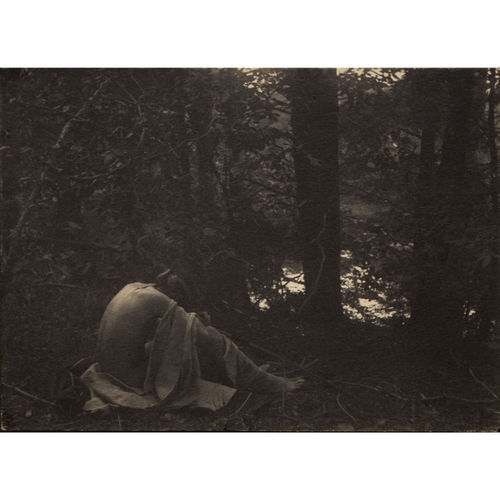
The first American to argue publicly that photography belonged among the fine arts, F. Holland Day (1864–1933) was a photographer, publisher, collector, and provocateur whose prominence at the turn of the century rivalled that of Alfred Stieglitz. He worked exclusively in platinum, drawn to its extraordinary detail and long, subtle tonal range, and often made only a single print from a negative. His subjects—religious tableaux, Orientalist studies, and male nudes drawn from Greco-Roman models—were controversial in his lifetime and remain central to the debate around his work today.
Born in Boston to a prosperous merchant family and raised in Norwood, Massachusetts, Day was a man of independent means throughout his life. He trained initially as a painter and assembled one of the world’s largest collections of material relating to the life and work of John Keats. In 1893, he co-founded the publishing house Copeland and Day, which produced exquisite hand-bound books in small editions, including works by Dante Gabriel Rossetti, his friend Oscar Wilde, and the American edition of The Yellow Book, the celebrated British art and literary journal of the 1890s. The firm published ninety-eight titles and never made a profit.
Day began photographing around 1886. He wrote extensively on photography as an art and organized international exhibitions to advance its cause. The high point came with The New School of American Photography, mounted at the Royal Photographic Society in London in 1900: 375 photographs by forty-two photographers, including 103 of his own, in what was the first exhibition of American Pictorialist photography in Europe. It elicited both high praise and open contempt, with one reviewer dismissing the exhibition as the product of a diseased imagination.
Day’s most audacious work is The Seven Last Words (1898), a sequence of closely staged self-portraits in which he portrayed Christ uttering the seven last words from the Cross. Day starved himself, grew out his beard, imported cloth and a cross from Syria, and staged an outdoor re-enactment of the Crucifixion with his neighbors in Norwood. The close-up portraits made immediately beforehand are the strongest images in the series. Edward Steichen wrote that few paintings had conveyed so powerfully a sense of the spiritual and the sacred. The photographs unsettled viewers then and continue to do so.
Day was eventually eclipsed by Stieglitz, while Pictorialism fell from favour with the arrival of modernism. A fire in 1904 destroyed some two thousand of his prints and negatives, and he lost interest in photography altogether when platinum became unobtainable following the Russian Revolution. His photographs are held in the collections of The Metropolitan Museum of Art, the Museum of Fine Arts, Boston, the Library of Congress, and the Norwood Historical Society, among others. Bruce Silverstein Gallery has presented his work in Photographer as Sculptor, Sculptor as Photographer (2025), REWIND (2021), and The Seven Words (2016).
-
 F. Holland DayNubia, 1896 - 1897Toned platinum print mounted to card, printed c. 1896 - 1897Image: 6 1/2 x 3 3/4 in (16.5 x 9.5 cm)
Mount: 8 1/8 x 6 in (20.6 x 15.2 cm) -
F. Holland DayKedan (Left Panel of Triptych Armageddon), 1897 - 1899Platinum print mounted to grey board with secondary mount, printed c. 1897 - 1899Image: 4 3/4 x 6 1/2 in (12.1 x 16.5 cm)
Mount: 10 3/4 x 13 1/4 in (27.3 x 33.7 cm) -
F. Holland DayUntitled (Right Panel of Triptych Armageddon), 1897 - 1899Platinum print mounted to grey board with secondary mount, printed c. 1897 - 1899Image: 4 7/8 x 6 1/2 in (12.4 x 16.5 cm)
Mount: 11 x 13 1/4 in (27.9 x 33.7 cm)


-

AIPAD 2026
23 - 26 Apr 2026BOOTH B01 For hours and events, visit AIPAD . Thursday, 4pm - Chester Higgins will be in our booth to talk about his photography. Friday,...Read more -

PARIS PHOTO 2019
7 - 10 Nov 2019Bruce Silverstein Gallery is pleased to present an exhibition that will include both iconic and lesser known photographs by some of the most important photographic...Read more -

AIPAD 2019
4 - 7 Apr 2019Read more -

PARIS PHOTO 2018
8 - 11 Nov 2018Recognized today as one of the most influential figures in modern photography, the Hungarian artist, designer and educator, György Kepes (1906-2001) was one of the...Read more -

FRIEZE MASTERS 2018
4 - 7 Oct 2018For Frieze Masters 2018, Bruce Silverstein Gallery would be pleased to present a selection of photographic masterpieces from the twentieth century created in the spirit...Read more -

FRIEZE MASTERS 2017
5 - 8 Oct 2017For Frieze Masters 2017, Bruce Silverstein proposes a curated exhibition featuring significant photographic works by Constantin Brancusi, Alfred Leslie, Rene Magritte, Man Ray, Henry Moore,...Read more -

PARIS PHOTO 2016
10 - 13 Nov 2016Bruce Silverstein Gallery is pleased to present at Paris Photo an exhibition inspired by one of the cornerstones of modern art, F. Holland Day’s seminal...Read more -

FRIEZE MASTERS 2016
6 - 9 Oct 2016Read more -

Frieze Masters 2014
15 - 19 Oct 2014For Frieze Masters 2014 Bruce Silverstein Gallery proposes a solo exhibition of the work of Keith Smith, an American artist active in the 1960s-80s. This...Read more