
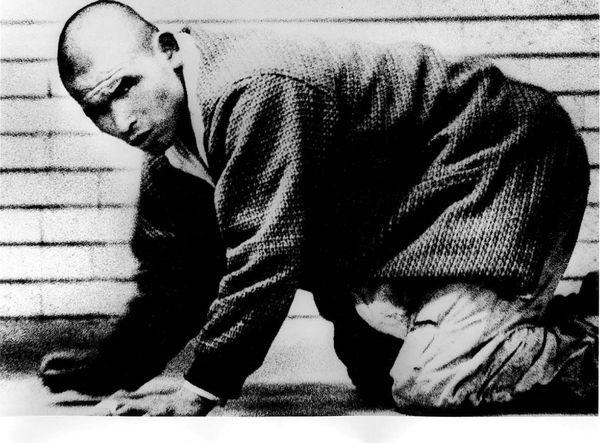
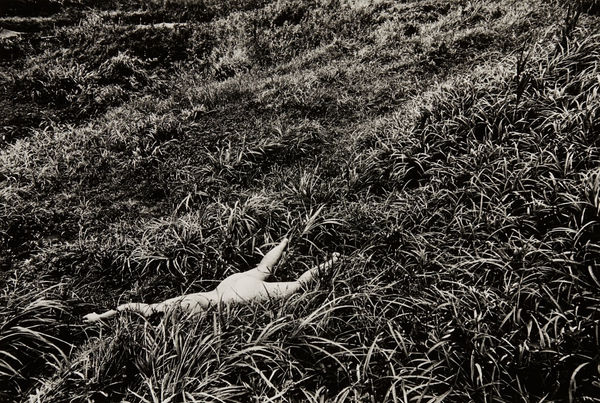
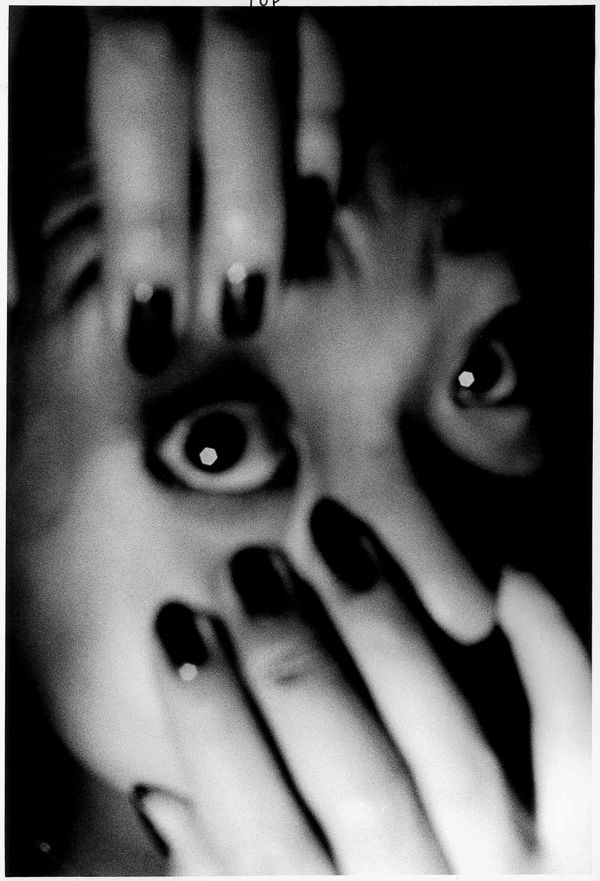
Daido Moriyama (b. 1938) is one of the most influential Japanese photographers of the postwar period. His radically subjective images of streets, people, signs and fragments of urban life transformed the possibilities of the photographic medium. High contrast, heavy grain, blur and oblique framing—the qualities described in Japanese criticism as are, bure, boke, or grainy, blurry and out of focus—are not failures in his work but deliberate means of conveying the instability and immediacy of experience. He often photographs without raising the camera to his eye, and for more than six decades has continually questioned what photography can be.
Born in Ikeda, Osaka, Moriyama trained in graphic design and bought his first camera, an inexpensive Canon, at the age of twenty. He worked in Osaka under the photographer Takeji Iwamiya before moving to Tokyo in 1961, where he joined the Vivo collective and became an assistant to Eikoh Hosoe. The work of William Klein and Shōmei Tōmatsu made a profound impression on him, as did the social and political unrest of the period. In 1964, he began working independently, receiving the New Artist Award of the Japan Photo Critics Association in 1967.
An admirer of Jack Kerouac, Moriyama hitchhiked along Japan’s new highways at all hours, stopping at deserted cafés and photographing through car windows. The resulting images were published serially in Camera Mainichi beginning in 1968. That same year, Japan: A Photo Theater transformed itinerant performers and the theatricality of everyday Japanese life into a heightened visual spectacle. His close friend Takuma Nakahira brought him into Provoke for its second issue in 1969. Within the highly political context of the group, Moriyama maintained an essentially apolitical position, while Farewell Photography (1972) pushed the photographic image toward its own destruction, incorporating film edges, dust and sprocket holes into the printed picture.
A visit to New York in 1969, where Moriyama encountered Andy Warhol’s silkscreens, gave him an idea that would become fundamental to his practice: duplication, repetition and mass production are intrinsic to photography rather than a betrayal of the medium. He began photographing photographs and reframing existing images, as in Accident (1969), made silkscreens of his own photographs, and returned repeatedly to the same motifs, including tights and lips. He rejects the veneration of the unique vintage print in favor of photography’s inherent reproducibility, continually reworking his images through different enlargements, crops and printings.
Much of Moriyama’s work has been conceived for the printed page rather than the gallery wall, and his bibliography now encompasses some 150 publications, among them Light and Shadow, Shinjuku, Tights and the long-running series Record. The city remains his enduring subject, above all Tokyo and Shinjuku, although his practice has taken him across New York, Paris, Buenos Aires and São Paulo. He works as readily in color and digitally as he does in black and white. His photographs were included in New Japanese Photography at The Museum of Modern Art in 1974, and a major retrospective organized with the Daido Moriyama Photo Foundation has travelled from São Paulo to Berlin, London, Helsinki, Lausanne and Vienna.
Bruce Silverstein Gallery announced its representation of Moriyama with the solo exhibition Within the Shadows and subsequently included his work in REWIND (2021).




-
 Daido MoriyamaEros or Something Other than Eros, 1969Gelatin silver print, printed later12 3/8 x 18 3/4 in (31.6 x 47.9 cm)
-
Daido MoriyamaSeparation, 1969Gelatin silver print, printed later11 3/8 x 16 1/4 in (29.1 x 41.3 cm)
-
Daido MoriyamaKagerou (Mayfly), 1972Gelatin silver print, printed later15 1/2 x 22 7/8 in (39.4 x 58.2 cm)
-
Daido MoriyamaTokyo, 1978Gelatin silver print, printed 19957 7/8 x 11 5/8 in (20.2 x 29.7 cm)
-
Daido MoriyamaUntitled, 1980sSilkscreen on paper, printed later11 1/8 x 16 3/8 in (28.4 x 41.6 cm)
-
Daido MoriyamaLight and Shadow #4 (Hat), 1982Gelatin silver print, printed later11 3/4 x 16 1/8 in. (30 x 41 cm)
-
Daido MoriyamaTokyo, Shinjuko, 1982Gelatin silver print, printed later9 x 13 3/8 in (23 x 34.2 cm)
-
Daido MoriyamaDocumentary 11 ('85.6 Setagaya-ku, Tokyo), 1985Silkscreen on paper, printed later12 1/8 x 16 3/8 in (31 x 41.7 cm)
-
Daido MoriyamaDocumentary 19, 1985Gelatin silver print, printed c. 198510 x 8 in. (25.4 x 20.32 cm)
-
Daido MoriyamaHow to Create a Beautiful Picture 6: Tights in Shimotakaido, 1987Silkscreen on paper, printed later10 x 15 in (25.5 x 38 cm)
-
Daido MoriyamaA Tale of II Cities, Tokyo, 1989Gelatin silver print, printed c. 198910 x 8 in (25.4 x 20.32 cm)
-
Daido MoriyamaDaido hysteric no. 4, 1993Gelatin silver print, printed c. 199511 5/8 x 9 1/2 in. (29.6 x 24.4 cm)
-
Daido MoriyamaUntitled, 1994Gelatin silver print, printed later22 x 16 3/8 in (55.8 x 41.8 cm)
-
Daido MoriyamaView from the Laboratory, 2008Gelatin silver print, printed later14 1/8 x 21 1/8 in. (35.9 x 53.9 cm)
-
Daido MoriyamaTights, 2017Gelatin silver print15 1/8 x 22 3/4 in (38.5 x 58.1 cm)




-
Y-3 Presents its Fall/Winter 2025 Collection with a Campaign Shot By Daido Moriyama
adidasY3 News, September 8, 2025 -
Daido Moriyama and Maica Arnado. United Athle has brought them together for a one-day pop-up store.
Naoya Tsuneshige, HOUYHNHNM: Hip fashion, culture, and lifestyle web magazine, August 20, 2025 -
From Daido to Araki: Inside Japan’s Postwar Avant-Garde Art Scene
Millen Brown-Ewens, AnOther Magazine, August 13, 2025 -
Inside Daido Moriyama’s mind-blowing early photo books
DazedAlessandro Merola, Dazed, August 4, 2025 -
The Tokyo Toilet Project / Daido Moriyama / Switch
July 31, 2025 -
Architects and designers take over Tokyo toilets in an project which inspired Wim Wenders
The Tokyo Toilet / Shibuya is Daido Moriyama’s photographic installation in and around high design toilets. The Tokyo Toilet project took centre stage in Perfect Days, the 2013 Wim Wenders filmMinako Norimatsu, Wallpaper*, July 30, 2025 -
EXHIBITION REVIEW: REWIND: 20TH ANNIVERSARY SHOW
Emily Capone, Musée: Vanguard of Photography Culture, January 10, 2022 -
DAIDO MORIYAMA RECEIVES 2019 HASSELBLAD FOUNDATION INTERNATIONAL AWARD IN PHOTOGRAPHY
Hasselblad Foundation, October 3, 2019 -
BRUCE SILVERSTEIN GALLERY WELCOMES DAIDO MORIYAMA
Annie Armstrong, Artnews, January 22, 2019




-
Daido Moriyama Love Letters to Photography
Fondation Henri Cartier-Bresson 20 May - 4 Oct 2026 Outside ExhibitionsFor Daido Moriyama, photography is alive, very much alive. Since the early 1960s, he has maintained a daily, almost existential relationship with it. He addresses photography through images, books and...Read more -
DAIDO MORIYAMA RETROSPECTIVE
FOTO ARSENAL WIEN 31 Jan - 10 May 2026 Outside ExhibitionsA dog in the shadows. Its fur is shaggy, its mouth slightly open, its gaze suspicious. As harsh light brushes its back, parts of its face disappear into deep black....Read more -
20th Anniversary Exhibition
REWIND 16 Dec 2021 - 19 Feb 2022 Gallery ExhibitionsBruce Silverstein Gallery is pleased to announce REWIND , a celebration of our 20th anniversary. Featuring works selected from over one hundred exhibitions, REWIND is an opportunity to revisit the...Read more -
Daido Moriyama
Within the Shadows 12 Sep - 19 Oct 2019 Gallery ExhibitionsBruce Silverstein Gallery is pleased to present a solo exhibition of work by world-renowned Japanese photographer Daido Moriyama. This is the gallery’s first show with the artist since announcing his...Read more -
Discoveries
A special selection of extraordinary photographs from the gallery's private inventory 16 Jun - 8 Aug 2009 Gallery ExhibitionsBruce Silverstein Gallery is pleased to announce DISCOVERIES , an exhibition featuring an eclectic selection of rare and noteworthy works by lesser-known artists from the 20th century.Read more



-

Daido Moriyama
2013Paperback, 144 pagesRead more
Publisher: Thames & Hudson
ISBN: 0500411050
Dimensions: 5 x 8 -

Daido Moriyama:
Record 2017Hardcover, 424 pagesRead more
Publisher: Thames & Hudson
ISBN: 0500544662
Dimensions: 9 x 11 -

Farewell Photography
Daido Moriyama , 2019Hardcover, 280 pagesRead more
Publisher: Getsuyosha Limited
ISBN: 4865030883
Dimensions: 12x9 -

Daido Moriyama
Kazuo Nishi, 2012Hardcover, 128 pagesRead more
Publisher: Phaidon Press
ISBN: 0714864722
Dimensions: 6 x 7 -

Daido Moriyama
Simon Baker, Minoru Shimizu, Koji Taki, 2013Paperback, 224 pagesRead more
Publisher: Tate Publishing
ISBN: 1849761396
Dimensions: 7 x 9 -

Daido Moriyama:
The World through My Eyes Daido Moriyama , 2010Hardcover, 440 pagesRead more
Publisher: Skira
Dimensions: 7 x 10 in. -

Labyrinth:
Daido Moriyama Daido Moriyama, 2012Paperback, 320 pagesRead more
Publisher: Aperture
ISBN: 1597112178
Dimensions: 9 x 12 -

Daido Moriyama:
Tales of Tono Daido Moriyama , 2013Paperback, 192 pagesRead more
Publisher: Tate/D.A.P.
ISBN: 1938922026
Dimensions: 5 x 7 -

Daido Moriyama in Color:
Now, And Never Again Daido Moriyama , 2016Hardcover, 489 pagesRead more
Publisher: Skira
ISBN: 8857222268
Dimensions: 9 x 13 -

Daido Moriyama:
How I Take Photographs Takeshi Nakamoto, 2019Paperback, 208 pagesRead more
Publisher: Laurence King Publishing
ISBN: 1786274248
Dimensions: 6 x 8 -

Daido Moriyama
Toda Masako, Yutaka Kambayashi, Satoshi Machiguchi, Kazuya Kimura , 2023Hardcover, 288 pagesRead more
Publisher: Prestel
ISBN: 3791389254
Dimensions: 9 x 11
-

PARIS PHOTO 2019
7 - 10 Nov 2019Bruce Silverstein Gallery is pleased to present an exhibition that will include both iconic and lesser known photographs by some of the most important photographic...Read more -

THE ARMORY SHOW 2019
7 - 10 Mar 2019Bruce Silverstein is delighted to return to The Armory Show for the landmark art fair’s 25th Anniversary edition. Exemplifying the gallery’s commitment to presenting important...Read more -

ART BASEL 2014
17 - 22 Jun 2014For Art Basel 45 Bruce Silverstein Gallery would be pleased to present an exhibition featuring rare, vintage prints by André Kertész created during his years...Read more -

AIPAD 2014
10 - 13 Apr 2014Read more -

THE ARMORY SHOW 2014
6 - 9 Mar 2014For The Armory Show 2014 Bruce Silverstein Gallery proposes an exhibition featuring the work of the artist Shinichi Maruyama. Over the past decade, Maruyama’s work...Read more -

FRIEZE MASTERS 2012
11 - 14 Oct 2012For Frieze Masters 2012, Bruce Silverstein Gallery proposes an exhibition of photographic works by the renowned artists Constantin Brancusi, André Kertész and Aaron Siskind that...Read more -

ART BASEL 2011
15 - 19 Jun 2011For Art Basel 42, Bruce Silverstein Gallery would be pleased to present an exhibition of photographic works by the world famous sculptor Constantin Brancusi. The...Read more