
Frederick Sommer (1905–1999) was an artistic polymath whose work across photography, painting, drawing, sculpture, collage, and music resists any hierarchy of mediums. He photographed the seemingly boundless Arizona desert, severed chicken parts, and the interiors of dead animals; made drawings and collages from anatomical illustrations; and devised a musical notation of his own. Working through unexpected juxtapositions of found images and objects, he pursued visual affinities that could be as unsettling as they were revelatory. His practice was grounded in a conviction that beauty might be discovered where others saw only the ordinary, the overlooked, or the grotesque, and in a sustained effort to expand the boundaries of what could be seen, assembled, and understood as art.
Born in Angri, Italy, in 1905 and raised in Rio de Janeiro, Sommer developed an early interest in art and landscape architecture. He completed a Master of Arts in landscape architecture at Cornell University. In his early thirties, a journey to Switzerland for health reasons became a catalyst for explorations across several disciplines. He eventually settled in Arizona, where he and his wife, Frances Sommer, made their home in Prescott in 1936, remaining there for the rest of their lives.
Sommer turned to photography after meeting Alfred Stieglitz in 1935 and Edward Weston in 1936. He replaced his smaller cameras with an eight-by-ten-inch view camera and developed a meticulous contact-printing practice distinguished by extraordinary tonal control. His desert landscapes, stripped of the horizon and framed as flattened fields of tone and texture, exemplify his approach: rather than offering a conventional view, they transform the landscape into an abstract arrangement of surfaces, rhythms, and forms. In 1940, he visited Charles Sheeler in New York; the following year, in California, he met Man Ray, Peggy Guggenheim, and, most consequentially, Max Ernst, with whom he developed a lasting friendship. When Ernst later settled in Sedona, the two artists continued an exchange that enriched their respective practices.
In dialogue with artists including Edward Weston, Max Ernst, Man Ray, and Aaron Siskind, Sommer forged a singular avant-garde practice informed by Surrealism, scientific illustration, and an unorthodox approach to appropriation. He dismantled and recombined existing images, discovering new meanings in their unexpected conjunctions decades before such strategies became central to postmodern art. Across his work, the boundaries between photography, drawing, painting, and collage remain deliberately porous, each medium offering another means of investigating the relationships between image, form, and perception.
Sommer’s work encompasses five principal bodies: photographs, drawings, paintings, collages, and musical scores. Among his most distinctive experiments were his glue-color drawings, made by applying pigments suspended in hide glue with a brush or nib. He began on the black interleaving sheets separating photographic film and later worked on drawing paper. He also produced cliché-verre negatives and camera-less images, contact-printing brushstrokes of oil paint on cellophane and arrangements of smoke and grease on plate glass. These experiments extended his interest in the photographic image beyond representation, treating light-sensitive materials and the processes of image-making as independent fields of artistic possibility.
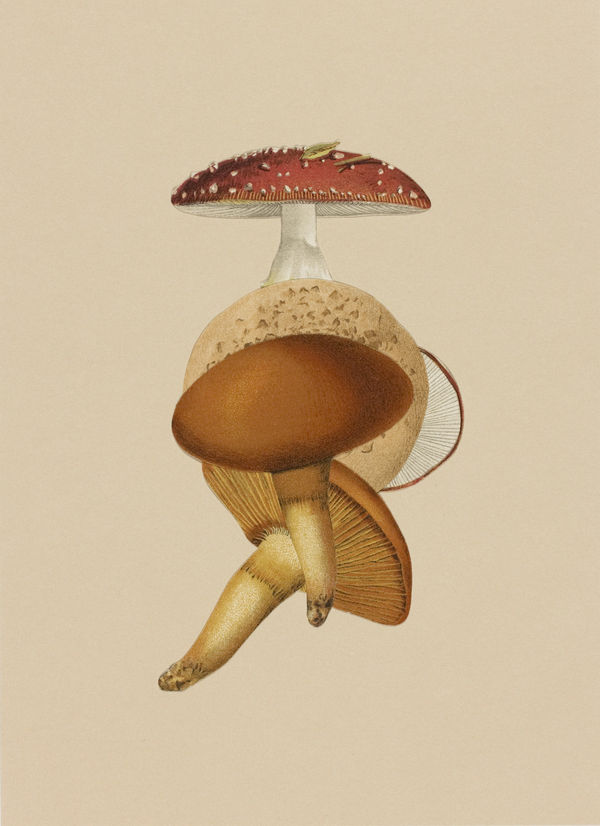
Sommer’s engagement with music emerged from a visit to a Los Angeles music library, where he encountered a display of original musical scores. This prompted him to explore the relationship between graphic form and musical composition. “One thing I became convinced of,” he observed, “and that has proven to be quite the case, [is] that only the really great composers are the ones who have good looking scores.” Beginning in 1941, he created musical scores of his own through the same intuitive, almost automatic process that informed his work in other mediums. Each was completed in a single session, guided by the proposition that a beautifully realized score might give rise to music of corresponding quality. His final body of work, produced between 1989 and 1999, consisted largely of collages assembled from anatomical illustrations, bringing his lifelong fascination with the body, found imagery, and unexpected visual correspondences to a culmination.
The Museum of Modern Art acquired Sommer’s work in 1941 for its exhibition Images of Freedom and has since included him in twenty-eight major exhibitions. Fluent in five languages, he pursued an intellectual life as expansive as his artistic practice, reading widely across literature, philosophy, critical theory, and quantum physics, from Goethe and Kant to Wittgenstein and Walter Benjamin. His work reflects this breadth of inquiry while remaining grounded in a fundamental conviction about the interconnectedness of all things. “Everything is shared by everything else,” he said. “There are no discontinuities.”
Sommer received the John Simon Guggenheim Fellowship in 1974 and died at Prescott in 1999, at ninety-three. His legacy lives on at the Frederick and Frances Sommer Foundation, and since 2010 Bruce Silverstein has shown two major retrospectives of his work.


-

ART BASEL MIAMI 2025 | Highlighting Lens-based Work in Meridians
Victoria Gonzalez and Milly Watson, MUSÉE, December 4, 2025 -
Rare Basquiat Photos and More Art to See in Miami This Week
Valentina Di Liscia, Hyperallergic, December 1, 2025 -
Photographer as Sculptor, Sculptor as Photographer
Rosario Ana Vizoli, Meer, June 10, 2025 -
Photographer as Sculptor, Sculptor as Photographer @ Bruce Silverstein
Just the FactsLoring Knoblauch , Collector Daily , May 30, 2025 -
Photographer as Sculptor, Sculptor as Photographer
ReviewGreer Valaquenta, Musée Magazine, May 1, 2025 -
Exhibition at Bruce Silverstein's new space explores the fascinating intersection on photography and sculpture
Art Daily, April 10, 2025 -
Photographer as Sculptor, Sculptor as Photographer
Meer, March 12, 2025 -
ANDRÉ KERTÉSZ AND FREDERICK SOMMER AT THE NATIONAL GALLERY OF ART
the National Gallery of Art, May 3, 2023 -
BARBARA MORGAN, AARON SISKIND, FREDERICK SOMMER
Royal Academy, September 24, 2016 -
REVIEW BY L'OEIL DE LA PHOTOGRAPHIE Songs and the Sky
The Eye of Photography, May 30, 2016 -
AARON SISKIND, FREDERICK SOMMER, AND KEITH SMITH AT MORGAN LIBRARY AND MUSEUM
The Morgan Library, March 25, 2016 -
‘Soldier, Spectre, Shaman,’ an Alternate History at MoMA
Jason Farago, the New York Times, November 5, 2015 -
Anne Doran, Time Out, June 30, 2015
-
ANDRÉ KERTÉSZ AND FREDERICK SOMMER AT BOWDOIN COLLEGE OF ART Under the Surface: Surrealist Photography
Bowdoin College Museum of Art, February 27, 2014 -
FREDERICK SOMMER AT THE NATIONAL GALLERY OF ART: A World of Bonds: Frederick Sommer’s Photography and Friendships
National Gallery of Art, June 13, 2013


-
Photographer as Sculptor, Sculptor as Photographer
10 Apr - 14 Jun 2025 Gallery ExhibitionsBruce Silverstein Gallery is pleased to present Photographer as Sculptor, Sculptor as Photographer , the inaugural exhibition of its new gallery space. This exhibition brings together sculptures and photographs by...Read more -
20th Anniversary Exhibition
REWIND 16 Dec 2021 - 19 Feb 2022 Gallery ExhibitionsBruce Silverstein Gallery is pleased to announce REWIND , a celebration of our 20th anniversary. Featuring works selected from over one hundred exhibitions, REWIND is an opportunity to revisit the...Read more -
Fredrick Sommer
Visual Affinities 24 Oct - 7 Dec 2019 Gallery ExhibitionsIn the span of an extraordinary career, Frederick Sommer worked in a variety of media—encompassing drawing, painting, photography, collage, and writing. Although celebrated for his achievements in photography, the artist...Read more -
Drawing the Line
11 Jul - 30 Aug 2019 Gallery ExhibitionsBruce Silverstein Gallery is pleased to announce a group exhibition featuring works by Harry Callahan, Germaine Krull, Shinichi Maruyama, Barbara Morgan, Sigmar Polke, Man Ray, Aaron Siskind, Keith A. Smith,...Read more -
Monochrome
20 Jan - 4 Mar 2017 Gallery ExhibitionsBruce Silverstein Gallery is pleased to present MONOCHROME, an exhibition including works by Alfred Leslie, Barbara Morgan, Louise Nevelson, Man Ray, Aaron Siskind, Frederick Sommer and John Wood.Read more -
Songs and the Sky
An Exhibition of Art and Music 28 Apr - 25 Jun 2016 Gallery ExhibitionsBruce Silverstein Gallery is pleased to present Songs and the Sky , an exhibition of art and music.Read more -
Fredrick Sommer
Glue Drawings 11 Jun - 31 Jul 2015 Gallery ExhibitionsBruce Silverstein is pleased to present an exhibition of Frederick Sommer’s glue color drawings from the 1930s-50s.Read more -
de-FORMATIONS
A group show featuring Andre Kertesz’s Distortions series 26 Feb - 18 Apr 2015 Gallery ExhibitionsIn 1933 André Kertész photographed two nude models in a carnival mirror as an assignment for the risqué publication Le Sourire. For a magazine often illustrated with erotic drawings, Kertész’s...Read more -
Fredrick Sommer
Choice and Chance, Structure Art and Nature 24 Feb - 2 Apr 2011 Gallery ExhibitionsBruce Silverstein / 20 and Ricco Maresca Gallery are pleased to announce a collaborative exhibition featuring the collages of Frederick Sommer. Containing some fifty examples from his prodigious output, dating...Read more -
DISCOVERIES
A special selection of extraordinary photographs from the gallery's private inventory 8 Jul - 6 Aug 2010 Gallery ExhibitionsBruce Silverstein Gallery is pleased to announce DISCOVERIES, an exhibition featuring an eclectic selection of rare and noteworthy works by 35 known and lesser-known artists from the 20 th century.Read more -
Fredrick Sommer
Circumnavigation 4 Feb - 20 Mar 2010Bruce Silverstein is pleased to announce Circumnavigation , an exhibition of the various media mastered by the artist Frederick Sommer.Read more




-

Paris Photo 2026
11 - 15 Nov 2026Opening Wednesday, November 11, 2026 (by invitation only) Collectors Circle: 11 a.m. – 9 p.m. VIP: 2pm – 9pm Early Access Collectors Circle & VIP...Read more -

AIPAD 2026
23 - 26 Apr 2026BOOTH B01 For hours and events, visit AIPAD . Thursday, 4pm - Chester Higgins will be in our booth to talk about his photography. Friday,...Read more -

ART BASEL MIAMI BEACH 2025
Pioneers of AbEx Photography; In Memoriam David Anfam (1955-2024) 3 - 7 Dec 2025BOOTH G3Read more -

Paris Photo 2025
12 - 16 Nov 2025Read more -

AIPAD 2022
20 - 22 May 2022Read more -

PARIS PHOTO 2019
7 - 10 Nov 2019Bruce Silverstein Gallery is pleased to present an exhibition that will include both iconic and lesser known photographs by some of the most important photographic...Read more -

AIPAD 2019
4 - 7 Apr 2019Read more -

THE ARMORY SHOW 2019
7 - 10 Mar 2019Bruce Silverstein is delighted to return to The Armory Show for the landmark art fair’s 25th Anniversary edition. Exemplifying the gallery’s commitment to presenting important...Read more -

PARIS PHOTO 2018
8 - 11 Nov 2018Recognized today as one of the most influential figures in modern photography, the Hungarian artist, designer and educator, György Kepes (1906-2001) was one of the...Read more -

FRIEZE MASTERS 2018
4 - 7 Oct 2018For Frieze Masters 2018, Bruce Silverstein Gallery would be pleased to present a selection of photographic masterpieces from the twentieth century created in the spirit...Read more -

THE ARMORY SHOW 2018
8 Mar 2018 - 11 Mar 2019Read more -

FRIEZE MASTERS 2017
5 - 8 Oct 2017For Frieze Masters 2017, Bruce Silverstein proposes a curated exhibition featuring significant photographic works by Constantin Brancusi, Alfred Leslie, Rene Magritte, Man Ray, Henry Moore,...Read more -

FRIEZE MASTERS 2016
6 - 9 Oct 2016Read more -

ART BASEL 2016
16 - 19 Jun 2016Read more -

AIPAD 2016
14 - 17 Apr 2016At the 2016 AIPAD Photography Show, Bruce Silverstein Gallery is proud to present Triumph of the Egg, featuring works of the same title by two...Read more -

THE ARMORY SHOW 2016
3 - 6 Mar 2016Read more -

AIPAD 2015
16 - 19 Apr 2015Read more -

THE ARMORY SHOW 2015
5 - 8 Mar 2015For the Armory Show 2015 Bruce Silverstein Gallery proposes an exhibition with a theme and focus encapsulated by the title, 'Low Culture'. Spanning multiple decades,...Read more -

Frieze Masters 2014
15 - 19 Oct 2014For Frieze Masters 2014 Bruce Silverstein Gallery proposes a solo exhibition of the work of Keith Smith, an American artist active in the 1960s-80s. This...Read more -

FRIEZE MASTERS 2015
14 Oct 2014 - 18 Oct 2015The gallery is pleased to present a selection of modern photographic masterpieces at Frieze Masters in London from October 14 to 18, 2015. Artists include...Read more -

ART BASEL 2014
17 - 22 Jun 2014For Art Basel 45 Bruce Silverstein Gallery would be pleased to present an exhibition featuring rare, vintage prints by André Kertész created during his years...Read more -

AIPAD 2014
10 - 13 Apr 2014Read more -

THE ARMORY SHOW 2014
6 - 9 Mar 2014For The Armory Show 2014 Bruce Silverstein Gallery proposes an exhibition featuring the work of the artist Shinichi Maruyama. Over the past decade, Maruyama’s work...Read more -

ART BASEL MIAMI 2013
5 Dec 2013 - 8 Dec 2015For Art Basel Miami Beach, Bruce Silverstein Gallery proposes an exhibition of rare vintage prints from the Equivalents series 1925-34, created by the artist and...Read more -

FRIEZE MASTERS LONDON 2013
17 - 20 Oct 2013For Frieze Masters 2013 Bruce Silverstein Gallery proposes an exhibition of works by Aaron Siskind. Photographer and educator Aaron Siskind holds a preeminent place in...Read more -

AIPAD 2013
4 - 7 Apr 2013Read more -

THE ARMORY SHOW 2012
8 - 11 Mar 2012Read more -

ART BASEL MIAMI 2011
1 - 4 Dec 2011For Art Basel Miami Beach, Bruce Silverstein Gallery proposes an exhibition exploring the notion of form as subject. We will display works by André Kertész,...Read more -

PARIS PHOTO 2011
10 - 13 Nov 2011For Paris Photo 2011, Bruce Silverstein Gallery proposes an exhibition exploring the notion of form as subject. We will display works by André Kertész, Edward...Read more -

ART BASEL 2011
15 - 19 Jun 2011For Art Basel 42, Bruce Silverstein Gallery would be pleased to present an exhibition of photographic works by the world famous sculptor Constantin Brancusi. The...Read more -

AIPAD 2011
17 - 20 Mar 2011Read more -

THE ARMORY SHOW 2011
2 - 6 Mar 2011Read more