
Dorothea Lange (1895–1965) made the photographs through which the Great Depression entered our collective memory. Migrant Mother, made at a pea-pickers’ camp in Nipomo, California, in March 1936, is among the most reproduced photographs in history. The larger body of work—sharecroppers, migrants, breadlines and the dispossessed of the Dust Bowl—established documentary photography as a powerful instrument of public argument.
Born in Hoboken, New Jersey, Lange contracted polio at the age of seven, leaving her with a permanent limp that she later said had shaped her character: “It humiliated me, guided me, instructed me and helped me.” She studied with Clarence H. White at Columbia University before moving to San Francisco in 1918, where she established a successful portrait studio. The Depression eventually drew her away from the studio and into the streets.
From 1935, Lange worked for the Resettlement Administration and, subsequently, the Farm Security Administration under Roy Stryker. Travelling with the economist Paul Taylor, whom she later married, she photographed the economic dislocation of rural America. Their 1939 book, An American Exodus, combined Lange’s photographs with Taylor’s field notes and the testimony of those they encountered, creating a new model for socially engaged photographic publication.
Migrant Mother depicts Florence Owens Thompson, aged thirty-two, with three of her seven children. Lange encountered the family at the end of a day’s work and made five exposures in approximately ten minutes, moving progressively closer to the subject. She transmitted the photographs to the San Francisco News, which published them within days; federal relief subsequently reached the camp. The negative remains in the Library of Congress with the Farm Security Administration archive. Because the image was produced as part of federal government work, it entered the public domain, contributing to its extraordinary circulation and its status as one of the defining images of twentieth-century America.
Lange’s government commissions also made her a critical observer of government policy. Her photographs of the incarceration of Japanese Americans at Manzanar and Tanforan in 1942 depict American citizens being tagged, assembled and confined with a stark directness that made the injustice impossible to overlook. The War Relocation Authority suppressed the photographs for the duration of the war; they entered the National Archives but were not widely published for more than six decades. Lange later photographed the Public Defender project in Oakland and, with Pirkle Jones, produced Death of a Valley, documenting the destruction of Berryessa Valley beneath a reservoir.
In 1941, Lange became the first woman photographer to receive a Guggenheim Fellowship. In 1952, she co-founded Aperture with Ansel Adams, Minor White and Nancy and Beaumont Newhall, and she continued to work internationally, photographing for Life in Ireland, Egypt and Asia. She died in 1965, only months before the retrospective she had prepared with John Szarkowski opened at The Museum of Modern Art—the Museum’s first exhibition devoted to a woman photographer.
Bruce Silverstein Gallery has presented Lange’s work in REWIND (2021), DISCOVERIES (2010) and TOPOGRAPHICS (2004).
-
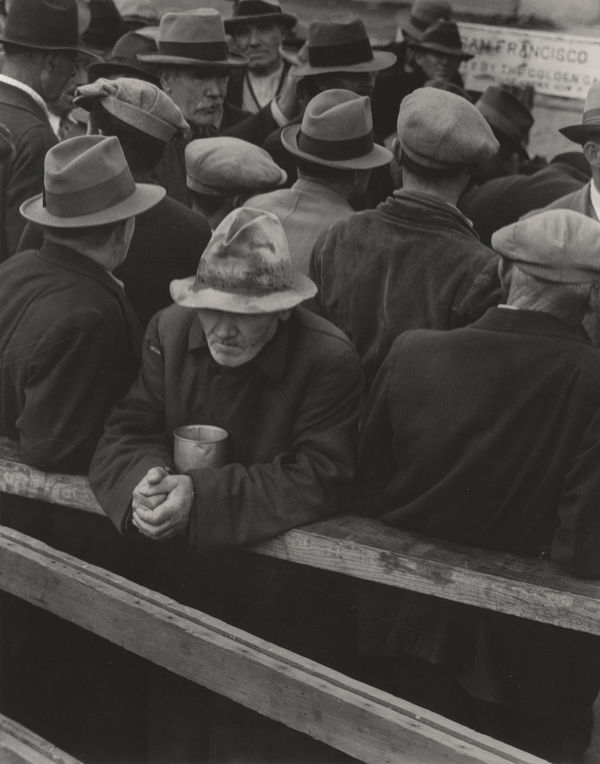
 Dorothea LangeWhite Angel Bread Line, San Francisco, CA, 1933Gelatin silver print, printed c. 1950s - 1960s9 7/8 x 8 in (25.1 x 20.3 cm)
-
Dorothea LangeMigrant Mother, 1936Gelatin silver print, printed c. 1960 - 19629 1/2 x 7 1/2 in (24.1 x 19.1 cm)
-
Dorothea LangeJ. R. Butler, President of the Southern Tenant Farmers Union, Memphis, Tennessee, 1938Flush-mounted gelatin silver print, printed c. 196513 x 10 in (33 x 25.4 cm)
-
Dorothea LangeKorean Child, 1958Gelatin silver print, printed c. 1958-19668 7/8 x 7 1/2 in (22.5 x 19.1 cm)


-
20th Anniversary Exhibition
REWIND 16 Dec 2021 - 19 Feb 2022 Gallery ExhibitionsBruce Silverstein Gallery is pleased to announce REWIND , a celebration of our 20th anniversary. Featuring works selected from over one hundred exhibitions, REWIND is an opportunity to revisit the...Read more -
DISCOVERIES
A special selection of extraordinary photographs from the gallery's private inventory 8 Jul - 6 Aug 2010 Gallery ExhibitionsBruce Silverstein Gallery is pleased to announce DISCOVERIES, an exhibition featuring an eclectic selection of rare and noteworthy works by 35 known and lesser-known artists from the 20 th century.Read more -
TOPOGRAPHICS
PHOTOGRAPHS FROM 1844 TO THE PRESENT 2 Oct - 13 Nov 2004 Gallery ExhibitionsRead more


-

AIPAD 2026
23 - 26 Apr 2026BOOTH B01 For hours and events, visit AIPAD . Thursday, 4pm - Chester Higgins will be in our booth to talk about his photography. Friday,...Read more -

Paris Photo 2025
12 - 16 Nov 2025Read more -

AIPAD 2025
23 - 27 Apr 2025Read more -

AIPAD 2022
20 - 22 May 2022Read more -

PARIS PHOTO 2019
7 - 10 Nov 2019Bruce Silverstein Gallery is pleased to present an exhibition that will include both iconic and lesser known photographs by some of the most important photographic...Read more -

AIPAD 2019
4 - 7 Apr 2019Read more -

PARIS PHOTO 2018
8 - 11 Nov 2018Recognized today as one of the most influential figures in modern photography, the Hungarian artist, designer and educator, György Kepes (1906-2001) was one of the...Read more -

FRIEZE MASTERS 2018
4 - 7 Oct 2018For Frieze Masters 2018, Bruce Silverstein Gallery would be pleased to present a selection of photographic masterpieces from the twentieth century created in the spirit...Read more -

AIPAD 2018
5 - 8 Apr 2018Read more -

PARIS PHOTO 2015
12 - 15 Nov 2015Read more -

AIPAD 2015
16 - 19 Apr 2015Read more -

Frieze Masters 2014
15 - 19 Oct 2014For Frieze Masters 2014 Bruce Silverstein Gallery proposes a solo exhibition of the work of Keith Smith, an American artist active in the 1960s-80s. This...Read more -

THE ARMORY SHOW 2014
6 - 9 Mar 2014For The Armory Show 2014 Bruce Silverstein Gallery proposes an exhibition featuring the work of the artist Shinichi Maruyama. Over the past decade, Maruyama’s work...Read more -

ART BASEL MIAMI 2013
5 Dec 2013 - 8 Dec 2015For Art Basel Miami Beach, Bruce Silverstein Gallery proposes an exhibition of rare vintage prints from the Equivalents series 1925-34, created by the artist and...Read more -

PARIS PHOTO 2013
14 - 17 Nov 2013Read more -

THE ARMORY SHOW 2013
7 - 10 Mar 2013Read more -

FRIEZE MASTERS 2012
11 - 14 Oct 2012For Frieze Masters 2012, Bruce Silverstein Gallery proposes an exhibition of photographic works by the renowned artists Constantin Brancusi, André Kertész and Aaron Siskind that...Read more -

ART BASEL MIAMI 2011
1 - 4 Dec 2011For Art Basel Miami Beach, Bruce Silverstein Gallery proposes an exhibition exploring the notion of form as subject. We will display works by André Kertész,...Read more -

ART BASEL 2011
15 - 19 Jun 2011For Art Basel 42, Bruce Silverstein Gallery would be pleased to present an exhibition of photographic works by the world famous sculptor Constantin Brancusi. The...Read more -

AIPAD 2011
17 - 20 Mar 2011Read more -

THE ARMORY SHOW 2011
2 - 6 Mar 2011Read more