
Mario Giacomelli (1925–2000) was among the most original and influential Italian photographers of the twentieth century, whose intensely personal vision transformed familiar subjects into powerful expressions of memory, mortality, and the passage of time. Self-taught and born into poverty, he spent his entire life in Senigallia, on Italy's Adriatic coast, photographing largely within the surrounding region. His subjects included young seminarians, elderly hospice residents, the inhabitants of Scanno, and the cultivated fields of the Marche. Through stark contrasts, pronounced grain, and experimental printing techniques, he reduced figures and landscapes to compositions of luminous whites and profound blacks, creating images that transcend documentary description. His poetic titles, often borrowed from literature, further reinforced the emotional and existential dimensions of his work.
Born in Senigallia, Giacomelli lost his father at nine and left school at thirteen to work in a printing shop. He pursued painting and poetry before establishing his own printing business in 1950, which he operated throughout his life. In 1953, he acquired his first camera and joined the Misa photographic group, founded under the influence of Giuseppe Cavalli. Combining the technical sensibility of a printer with the expressive freedom of a painter, Giacomelli developed a distinctive approach that pushed photographic contrast and tonal relationships to their extremes. Working with a modified Kobell Press camera, he transformed figures into almost calligraphic forms against luminous backgrounds.
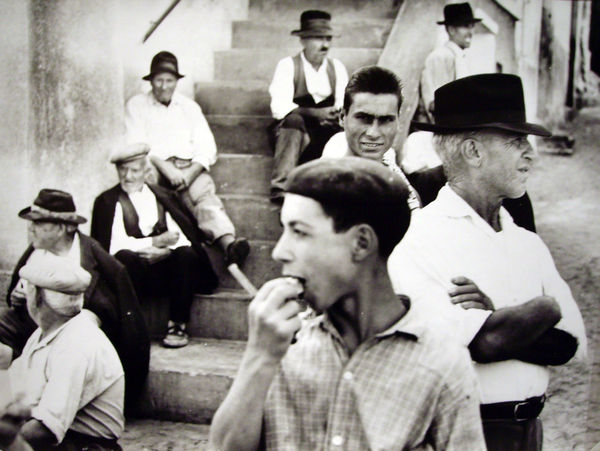
His first major series, photographed in 1954 at the hospice where his mother worked, became Verrà la morte e avrà i tuoi occhi (There Will Be Death and It Will Have Your Eyes), titled after a poem by Cesare Pavese. These stark, intimate photographs of elderly residents confront aging, vulnerability, and mortality with unusual directness. In 1957 and 1959, Giacomelli traveled to Scanno, a village in the Abruzzo region previously photographed by Henri Cartier-Bresson. Describing the village as a fairy-tale setting inhabited by small black figures, he employed extreme contrast and overexposure to transform its streets and inhabitants into enigmatic, almost metaphysical compositions. His celebrated Scanno Boy depicts blurred, shadowlike figures surrounding a sharply defined young boy, creating an arresting tension between movement and stillness, presence and disappearance. The image transcends reportage, approaching the psychological intensity of Italian pittura metafisica.
Between 1961 and 1963, Giacomelli photographed seminarians in Senigallia, producing Io non ho mani che mi accarezzino il volto (I Have No Hands to Caress My Face), named after a poem by Father David Maria Turoldo. Depicting young priests playing, gesturing, and moving through snow, the series balances innocence and ritual, discipline and spontaneity. His radical manipulation of light and shadow transforms these moments into evocative expressions of isolation, spiritual longing, and human vulnerability.
Scanno Boy brought Giacomelli international recognition when it appeared in the British Journal of Photography Annual in 1963, the same year John Szarkowski acquired the photograph for The Museum of Modern Art in New York. Szarkowski subsequently included it in The Photographer's Eye (1964) and Looking at Photographs (1973), establishing its significance within postwar photography. In 1975, Bill Brandt selected Giacomelli's work for The Land at London's Victoria and Albert Museum, and in 1978 he exhibited at the Venice Biennale. Following his death in Senigallia in 2000, a major retrospective of 250 works was presented in Rome in 2001. His extensive Phaidon monograph, edited by Alistair Crawford, further established his international reputation.
Giacomelli's photographs are held in major collections, including The Museum of Modern Art, the Metropolitan Museum of Art, the J. Paul Getty Museum, and the Art Institute of Chicago. Bruce Silverstein Gallery has presented his work in Mario Giacomelli: Earthly Inferno (2007), Discoveries (2010), REWIND (2021), Summer Glow (2024), and In Sequence (2025).
-
 Mario GiacomelliPugilia No. 252, 1958Gelatin silver print12 x 16 in (30.5 x 40.6 cm)
-
Mario GiacomelliFigura No. 130, 1965Gelatin silver print, printed c. 196512 x 16 in (30.48 x 40.64 cm)
-
Mario GiacomelliUntitled, n.d., printed after 1970Gelatin silver print11 1/4 x 14 in (28.6 x 35.6 cm)


-
DISCOVERIES
A special selection of extraordinary photographs from the gallery's private inventory 8 Jul - 6 Aug 2010 Gallery ExhibitionsBruce Silverstein Gallery is pleased to announce DISCOVERIES, an exhibition featuring an eclectic selection of rare and noteworthy works by 35 known and lesser-known artists from the 20 th century.Read more -
Mario Giacomelli
Earthly Inferno 22 Feb - 31 Mar 2007 Gallery ExhibitionsBruce Silverstein Gallery is pleased to announce Mario Giacomelli Earthly Inferno , a survey of photographs by Italy’s most prolific and highly regarded photographer.Read more -
TOPOGRAPHICS
PHOTOGRAPHS FROM 1844 TO THE PRESENT 2 Oct - 13 Nov 2004 Gallery ExhibitionsRead more


