Opening reception | Thursday, April 16th, 2026 | 6 - 8 PM
Bruce Silverstein Gallery is pleased to present Chester Higgins: Shared Memories, the gallery’s third exhibition of work by Chester Higgins. Featuring over forty black and white and color works spanning six decades, the exhibition brings into view one of the most enduring and consequential bodies of work devoted to the African diaspora in contemporary photography. Across generations and continents, Higgins has undertaken a sustained visual reckoning with history, identity, and inheritance, creating a record that restores presence where it has been obscured and asserts dignity where it has been denied. His photographs stand as both witness and affirmation, reclaiming the cultural and spiritual depth of Black life within the broader narrative of modern history. Shared Memories gathers this lifelong commitment into a singular statement of continuity, collective memory, pride, and authority.
“I make my images to bear witness to our presence, to the real and widespread accomplishments of people of African descent,” Higgins has said. From the beginning of his career, photography has been for him an act of responsibility. “I love the work that I do using my camera to make love to my people and my community.” His subjects are not distant observers of history; they are participants in it. That closeness defines his practice.
Born in Fairhope, Alabama in 1946 and raised in rural southern Alabama during the height of the Civil Rights movement, Higgins began photographing within a community shaped by economic limitation and segregation yet sustained by church, family, and the intellectual presence of Tuskegee University. His earliest work emerged from recognition within that environment. By 1969, he was photographing in New York City while continuing to return South, moving between regional and urban Black life without abandoning either. The city expanded his field of vision but did not displace his origins; it sharpened his awareness of the scale and diversity of Black experience within the United States.
By the time he traveled to Senegal in 1971, Higgins’s understanding of Black history was already deeply formed by the American South and the political awakenings of the 1960s. Africa did not introduce him to identity; it expanded it. Since that first journey, he has undertaken more than two dozen extended trips across West, East, and North Africa while continuing to document diasporic life throughout the Americas. These were not isolated visits but decades-long engagements.
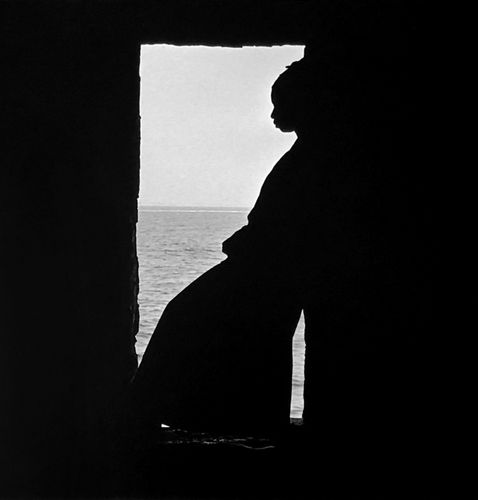
In The Door of No Return 1972, made at Gorée Island, Higgins confronts the threshold from which millions were forced into exile. The image refuses spectacle. It acknowledges rupture while insisting on survival and continuity. Candomblé initiate, Brazil 1989 affirms that African spiritual traditions endured across the Atlantic in living ritual form, revealing inheritance not as memory alone but as practice. A Young Muslim Woman in Brooklyn 1990 dissolves geography, suggesting that diaspora resides not in distance but in lived identity. In African American pilgrims dance in honor of ancient spirits, Lake Nasser, Egypt 2006, return becomes voluntary and celebratory, history engaged not as trauma but as inheritance consciously reclaimed.
Created decades later, State of Affairs 2018 situates this lifelong inquiry within the American present. Made during a period of renewed national reckoning around race and citizenship, the image confronts the American flag as contested ground. A silhouetted hand pressed against its surface underscores that affirmation and struggle coexist within the same frame. Higgins’s photographs celebrate Black identity, culture, heritage, and family life, yet they remain attentive to structural inequities and racial injustice. Pride and protest exist side by side throughout his career.
Alongside his independent practice, Higgins served for nearly forty years as a staff photographer for The New York Times, where his images reached millions and played a defining role in reshaping how Black Americans were represented in the public sphere. Entering journalism with a corrective purpose, he sought to redefine how Black men and women were visually understood. He photographed families at home, fathers and sons in proximity, graduates stepping forward, communities at worship, elders honored, and children poised at the beginning of possibility. At a time when mainstream media often reduced Black life to crisis or caricature, his photographs presented complexity, dignity, aspiration, and spiritual depth. For many African Americans, these images became a visible source of pride; for broader audiences, they expanded public understanding beyond stereotype. “The photograph never lies about the photographer,” he has observed, and his work reflects a consistent and deliberate commitment to dignity.
His monumental and ongoing Black Pantheon project, comprising more than 250 portraits created across seven decades, honors cultural, political, intellectual, and artistic leaders whose work has shaped modern history. More than a portrait series, it stands as a living archive of leadership and presence, reinforcing his conviction that visibility is inseparable from memory.
Higgins’s photographs are held in major museum collections, including The Metropolitan Museum of Art, The Museum of Modern Art, The Brooklyn Museum, and the Smithsonian American Art Museum. Photography historian Deborah Willis has written that his images insist upon interiority and spiritual presence, expanding the visual vocabulary through which Black life is understood and situating him within a lineage of artists who have reshaped American visual history by centering Black self-authorship and visual agency.
Beyond institutional recognition, the enduring power of Higgins’s work lies in proximity. He photographs not from distance but from kinship. His subjects are brothers and sisters, elders and children, individuals whose dignity he considers nonnegotiable. From the insular South of his youth to a global diaspora, that commitment has remained unwavering. Shared Memories affirms what his career has consistently demonstrated: that Black life, across continents and generations, carries its own authority and enduring presence in history.
