
Michael Wolf (1954–2019) devoted his photographic practice to the complexities of contemporary urban life, exploring the tensions between density and isolation, public and private space, and individual identity and collective anonymity. Working primarily in Hong Kong, as well as Chicago, Tokyo, and Paris, Wolf developed a distinctive visual language that ranged from rigorously composed large-format photographs to works appropriating imagery generated by digital technologies. At the heart of his practice was a sustained investigation into the human experience of the modern metropolis and the profound psychological and social consequences of urbanization. His photographs function not only as incisive observations of contemporary life but also as acts of preservation, recording the people, places, and vernacular details increasingly threatened by the relentless transformation of the urban landscape.
Born in Munich in 1954 to artists Anna and Arne Wolf, Wolf spent his formative years in the United States, Europe, and Canada. He studied at the University of California, Berkeley, before completing his degree in visual communication in 1976 at the Folkwang School in Essen, where he studied under the influential German photographer Otto Steinert. Wolf subsequently established himself as a photojournalist, contributing to publications including Geo and Stern. Following his relocation to Hong Kong in 1994, he worked for eight years as a contract photographer for Stern before abandoning editorial assignments in 2003 to devote himself entirely to his independent artistic practice.
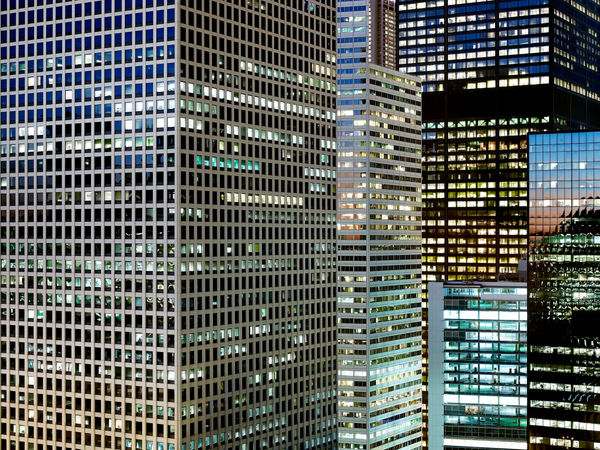
Wolf's major bodies of work challenged conventional approaches to architectural and street photography, establishing a compelling dialogue between formal abstraction and the human condition. In Architecture of Density, he transformed Hong Kong's monumental residential towers into tightly framed, nearly abstract compositions. By eliminating the sky, horizon, and other conventional spatial references, Wolf reduced imposing facades to intricate grids of windows, balconies, and repetitive architectural forms. These photographs extend the formal concerns of the New Topographics tradition while confronting the extraordinary scale and anonymity of high-density urban habitation. In 100 x 100, Wolf turned his attention inward, documenting one hundred diminutive, one-hundred-square-foot apartments in Hong Kong's Shek Kip Mei housing estate. Together, these series reveal the relationship between the monumental scale of urban development and the intimate realities of individual existence.
In The Transparent City (2007), photographed in Chicago, Wolf explored the glass-and-steel architecture of the modern American metropolis. Through illuminated windows and reflective curtain walls, he captured fragments of private life suspended within vast architectural grids. The resulting photographs oscillate between abstraction and narrative, inviting viewers to examine the uneasy intersection of visibility, privacy, and voyeurism. The monumental architectural compositions and their intimate human details become inseparable, underscoring Wolf's ability to move between the scale of the city and the vulnerability of its inhabitants.
Wolf pursued these concerns with particular intensity in Tokyo Compression, photographing commuters pressed against the windows of overcrowded subway trains. Condensation, reflections, and the physical confinement of the passengers produce images of extraordinary psychological immediacy. Faces emerge from fogged glass, while others retreat behind closed eyes or protective masks, conveying the exhaustion, resignation, and alienation of daily metropolitan life. The series, which concluded in 2013 following the relocation of the Odakyu railway line, stands among Wolf's most affecting investigations of the human cost of urban density.
Wolf's engagement with contemporary visual culture extended beyond traditional photographic practice. In Paris Street View and A Series of Unfortunate Events, he appropriated imagery from Google Street View, isolating fleeting gestures, unexpected encounters, and moments of vulnerability within an immense, mechanically generated visual archive. By reframing these images, Wolf challenged established notions of photographic authorship, observation, and the decisive moment while interrogating the implications of surveillance and the proliferation of digital imagery. Running parallel to these investigations were his intimate studies of Hong Kong's vernacular environment: back alleys, improvised seating, aging corner buildings, and laundry suspended between structures. These photographs preserve the ingenuity and particularities of everyday life, revealing an enduring sensitivity to the ephemeral character of the city's material culture.
Wolf received first prize in the World Press Photo competition in 2005 and 2010 and was shortlisted for the prestigious Prix Pictet in 2010 and 2016. His work was presented at the Victoria and Albert Museum in London in conjunction with the 2016 Prix Pictet. In 2017, his major retrospective, Life in Cities, premiered at Les Rencontres d'Arles before traveling to the Deichtorhallen in Hamburg, Fotomuseum Den Haag, and Fondazione Stelline in Milan. Over the course of his career, Wolf published more than twenty monographs, beginning with Sitting in China (2002) and including the comprehensive Michael Wolf Works (2017).
Wolf's association with Bruce Silverstein Gallery began in 2010 with his exhibition iseeyou. That same year, he curated CITY VIEWS: André Kertész for the gallery, reflecting his profound engagement with the history of photography and his affinity for artists who explored the visual and psychological dimensions of urban life. In 2019, the gallery presented Metropolis, an exhibition honoring Wolf's life and artistic legacy.
Through a body of work distinguished by formal precision, conceptual rigor, and an abiding concern for the human condition, Michael Wolf expanded the possibilities of contemporary photography. His images reveal the modern city as both an architectural spectacle and an intensely personal environment, where individual lives unfold within increasingly vast and impersonal systems. His work remains a compelling examination of urban existence and a lasting testament to photography's capacity to transform the ordinary into the extraordinary.
Bruce Silverstein Gallery represents the Estate of Michael Wolf.


-

EXHIBITION REVIEW: REWIND: 20TH ANNIVERSARY SHOW
Emily Capone, Musée: Vanguard of Photography Culture, January 10, 2022 -
CIVILIZATION: THE WAY WE LIVE NOW
National Gallery of Victoria, September 13, 2019 -
MICHAEL WOLF: A ride in hell? An up-close look at real life in megacities
Zahra Jamshed, CNN, December 5, 2017 -
THEARTSDESK AT LES RENCONTRES D'ARLES: BREADTH AND DEPTH AT THE VETERAN PHOTO FESTIVAL
Bill Knight, The Arts Desk, July 8, 2017 -
ARLES 2017 – WHAT WE MISSED
Eye of Photography, July 3, 2017 -
'THE TRANSPARENT CITY' Photographer captures a fragment of life in Chicago
New York Daily News, June 28, 2017 -
STRIKING PHOTOS SHOW THE REALITY OF THE TOKYO COMMUTE
Fiona Macdonald, BBC Culture, June 23, 2017 -
LIFE IN THE CITY: MICHAEL WOLF’S MAJOR RETROSPECTIVE AT LES RENCONTRES D’ARLES 2017
Michael Wolf, Lensculture, June 10, 2017 -
MICHAEL WOLF Michael Wolf's best photograph: four plucked ducks in Hong Kong
Natalie Rigg, The Guardian, April 19, 2017 -
MICHAEL WOLF: REUTERS VIDEO Photographer captures Hong Kong’s unique urban culture
REUTERS, March 15, 2016 -
MICHAEL WOLF: POST MAGAZINE Informal Solutions
Mark Footer, Post Magazine, February 10, 2016 -
MICHAEL WOLF: NEW YORK TIMES Little Room for Embellishment in Densely Packed Hong Kong
Andrew Frew McMillan, the New York Times, August 27, 2015 -
MICHAEL WOLF AT THE ACKLAND ART MUSEUM
Photovision, September 19, 2014


-
Urban Impressions: Experiencing the Global Contemporary Metropolis
Moody Center for the Arts 16 Sep - 22 Dec 2022 Outside ExhibitionsRead more -
20th Anniversary Exhibition
REWIND 16 Dec 2021 - 19 Feb 2022 Gallery ExhibitionsBruce Silverstein Gallery is pleased to announce REWIND , a celebration of our 20th anniversary. Featuring works selected from over one hundred exhibitions, REWIND is an opportunity to revisit the...Read more -
Michael Wolf
Metropolis 24 Oct - 21 Dec 2019 Gallery ExhibitionsBruce Silverstein is proud to present an exhibition dedicated to celebrating Michael Wolf’s life and prolific photographic legacy.Read more -
MICHAEL WOLF: LIFE IN CITIES
Urania, Berlin 16 Jun - 14 Aug 2019 Outside ExhibitionsRead more -
Michael Wolf
iseeyou 27 Oct - 24 Dec 2010 Gallery ExhibitionsBruce Silverstein Gallery is pleased to present iseeyou , a groundbreaking and provocative exhibition by German photographer Michael Wolf. Encompassing four bodies of work—Transparent City, Architecture of Density, Tokyo Compression,...Read more


-

Hong Kong Inside Outside
Michael Wolf, 2009Hardcover, 352 pagesRead more
Publisher: Pepperoni Books
ISBN: 9783941825048
Dimensions: 12 x 9¼ in -

A Series of Unfortunate Events
Michael Wolf, 2010Hardcover, 72 pagesRead more
Publisher: Wanderer Books
ISBN: 3941825100
Dimensions: 6.14 x 0.59 x 8.07 in -

FY
Michael Wolf, 2011Hardcover, 40 pagesRead more
Publisher: Wanderer Books
ISBN: 3941825194
Dimensions: 9 1/8 x 6 3/4 in -

Real Fake Art
Michael Wolf, 2011Hardcover, 112 pagesRead more
Publisher: Pepperoni Books, Asia One
ISBN: 3941825208
Dimensions: 13 1/4 x 9 7/8 -

Architecture Of Density
Michael Wolf, 2012Print, 28 pagesRead more
Publisher: Peperoni Books
ISBN: 9881799880 -

Michael Wolf Works
Michael Wolf, 2017Hardcover, 296 pagesRead more
Publisher: Peperoni Books
ISBN: 3941249207
Dimensions: 9.76 x 1.38 x 11.77 in
-

Paris Photo 2026
11 - 15 Nov 2026Opening Wednesday, November 11, 2026 (by invitation only) Collectors Circle: 11 a.m. – 9 p.m. VIP: 2pm – 9pm Early Access Collectors Circle & VIP...Read more -

The Armory Show 2026
24 - 27 Sep 2026Booth 310 For hours and events visit The Armory ShowRead more -

Paris Photo 2025
12 - 16 Nov 2025Read more -

AIPAD 2023
30 Mar - 2 Apr 2023Read more -

PARIS PHOTO 2019
7 - 10 Nov 2019Bruce Silverstein Gallery is pleased to present an exhibition that will include both iconic and lesser known photographs by some of the most important photographic...Read more -

AIPAD 2019
4 - 7 Apr 2019Read more -

AIPAD 2018
5 - 8 Apr 2018Read more -

PARIS PHOTO 2016
10 - 13 Nov 2016Bruce Silverstein Gallery is pleased to present at Paris Photo an exhibition inspired by one of the cornerstones of modern art, F. Holland Day’s seminal...Read more -

AIPAD 2016
14 - 17 Apr 2016At the 2016 AIPAD Photography Show, Bruce Silverstein Gallery is proud to present Triumph of the Egg, featuring works of the same title by two...Read more -

PARIS PHOTO 2015
12 - 15 Nov 2015Read more -

THE ARMORY SHOW 2015
5 - 8 Mar 2015For the Armory Show 2015 Bruce Silverstein Gallery proposes an exhibition with a theme and focus encapsulated by the title, 'Low Culture'. Spanning multiple decades,...Read more -

THE ARMORY SHOW 2014
6 - 9 Mar 2014For The Armory Show 2014 Bruce Silverstein Gallery proposes an exhibition featuring the work of the artist Shinichi Maruyama. Over the past decade, Maruyama’s work...Read more -

ART BASEL MIAMI 2013
5 Dec 2013 - 8 Dec 2015For Art Basel Miami Beach, Bruce Silverstein Gallery proposes an exhibition of rare vintage prints from the Equivalents series 1925-34, created by the artist and...Read more -

THE ARMORY SHOW 2013
7 - 10 Mar 2013Read more -

ART BASEL MIAMI 2012
6 - 9 Dec 2012For Art Basel Miami Beach, Bruce Silverstein Gallery proposes an exhibition of Constantin Brancusi’s photographs—rare vintage prints by the artist from the 1920s and 30s....Read more -

AIPAD 2012
29 Mar - 1 Apr 2012Read more -

THE ARMORY SHOW 2012
8 - 11 Mar 2012Read more -

ART BASEL MIAMI 2011
1 - 4 Dec 2011For Art Basel Miami Beach, Bruce Silverstein Gallery proposes an exhibition exploring the notion of form as subject. We will display works by André Kertész,...Read more -

PARIS PHOTO 2011
10 - 13 Nov 2011For Paris Photo 2011, Bruce Silverstein Gallery proposes an exhibition exploring the notion of form as subject. We will display works by André Kertész, Edward...Read more -

ART BASEL 2011
15 - 19 Jun 2011For Art Basel 42, Bruce Silverstein Gallery would be pleased to present an exhibition of photographic works by the world famous sculptor Constantin Brancusi. The...Read more -

AIPAD 2011
17 - 20 Mar 2011Read more -

THE ARMORY SHOW 2011
2 - 6 Mar 2011Read more