
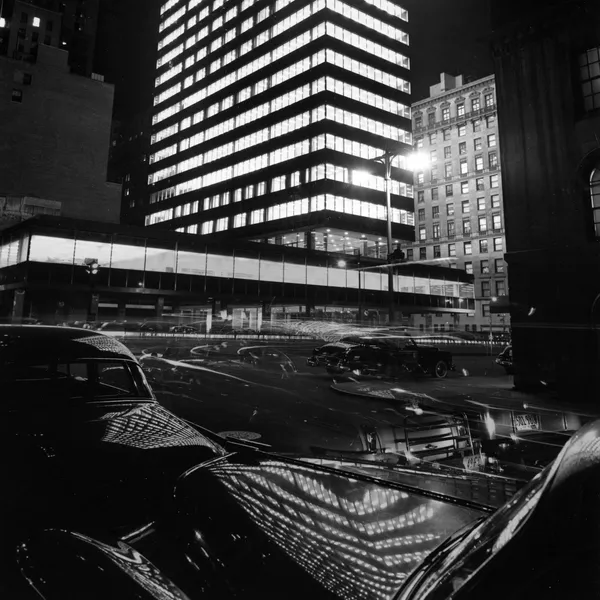
André Kertész (1894 – 1985) a seminal figure in twentieth-century photography, began his brilliant and innovative career in 1912 and worked seventy-three years, across Hungary, Paris, and New York. Neither a pure Surrealist nor a strict photojournalist, he combined a street photographer’s wry humor with the formal sensibility of a modernist. His ability to construct lyrical images infused with wit and insight remained a constant throughout his long career. His use of unconventional vantage points, unexpected lighting, reflection, distortion, and radical cropping produced some of the most iconic photographs in the history of the medium. He would influence a generation of photographers, including Bill Brandt, Robert Capa, and Henri Cartier-Bresson, who famously said, “Whatever we have done, Kertész did first.”
Born in Budapest in 1894 and trained for a career in finance, Kertész bought his first camera in 1912 while working as a clerk at the Budapest Stock Exchange. His early images of family members and the Hungarian countryside reflect his engagement with contemporary Hungarian artists during a period of extraordinary cultural growth. Drafted into the Austro-Hungarian army in 1914, he took his camera to the front lines, and in 1917, while convalescing from a wound, made Underwater Swimmer, in which a body appears elongated and dissolved by the water. Kertész called it his first distortion. He moved to Paris in 1925, but his modernist approach had already begun to take shape.
In Paris, his pioneering vision brought him considerable success, and his approach helped define the emerging language of photojournalism in Europe and, subsequently, America. Over eleven years, he made the work for which he remains best known, including Chez Mondrian (1926), Satiric Dancer (1926), and Fork (1928). Moving among the artists of Montparnasse, he photographed the studios of Piet Mondrian and Constantin Brâncuși as portraits made in the sitter’s absence. He introduced Brassaï to photography and published four books, beginning with Enfants in 1933, the year he made Distortions, a series of nudes photographed through funhouse mirrors for the magazine Le Sourire.
Kertész left for New York in 1936, and from the beginning his career in the United States proved difficult. American editors found his images too poetic for their stories and layouts, and, unable to return to Europe after the outbreak of war, he was classified as an enemy alien and warned not to photograph in the streets. Day of Paris, published in 1945 and now regarded as a canonical photobook, did not change his position. He worked under contract to Condé Nast until 1962, years he later described as his “lost years.”
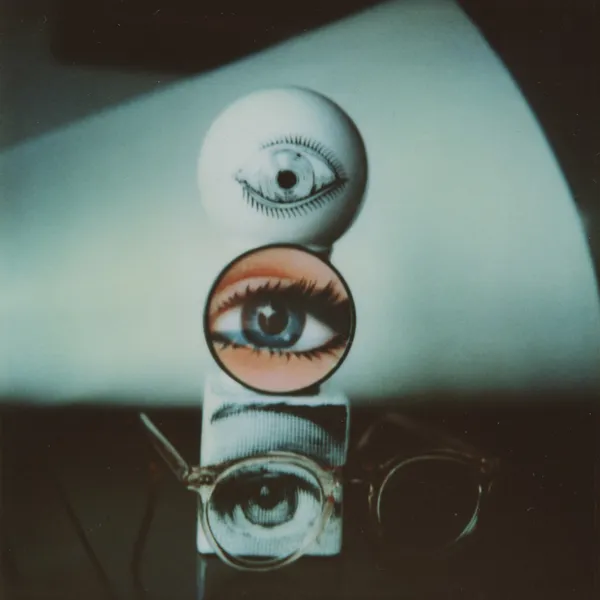
At sixty-eight, he broke the contract and returned fully to his art. John Szarkowski’s 1964 retrospective at The Museum of Modern Art restored the reputation he had enjoyed in Europe, and Szarkowski wrote that Kertész’s work, perhaps more than any other photographer’s, defined the direction in which modern European photography developed. From his apartment at 2 Fifth Avenue, he continued photographing Washington Square Park through the window. After his wife, Elizabeth, died in 1977, he turned to the Polaroid SX-70 and to color, working until his death in 1985.
In 1984, Kertész gave his negatives and archive to the French Ministry of Culture, a donation of more than 100,000 negatives now held by the Médiathèque du patrimoine et de la photographie in Paris. Prints signed by Kertész generally do not bear the estate stamp, which was applied only after his death to identify later prints as originals.
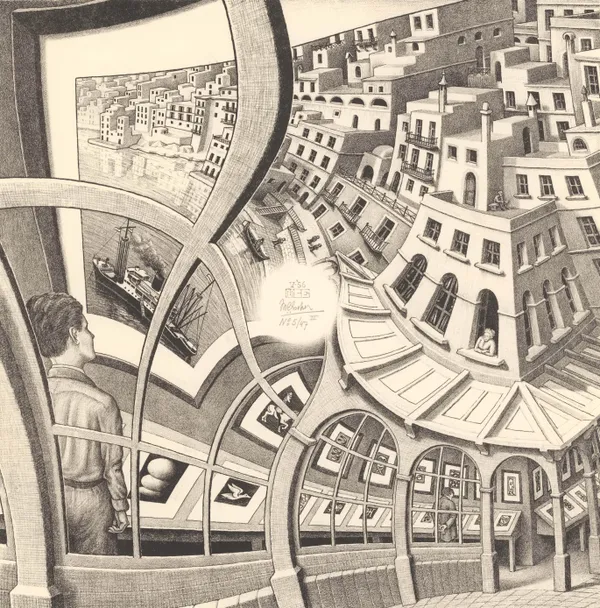
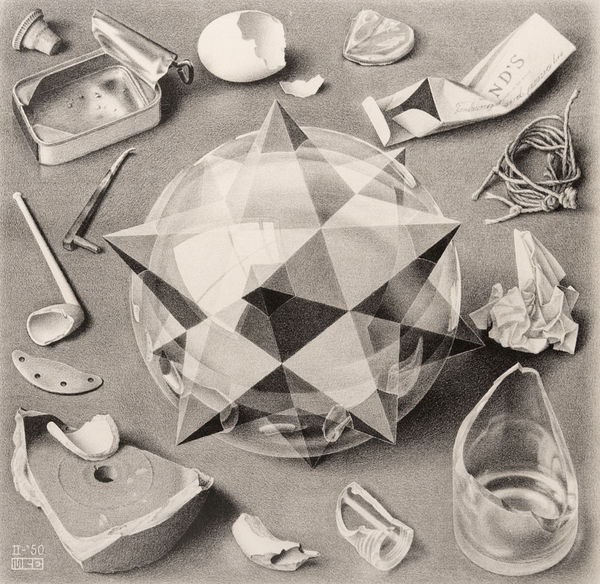
Bruce Silverstein Gallery has presented his work in Between Order and Chaos: André Kertész and M. C. Escher (2026), The Visual Language of Modernity (2023), REWIND (2021), André Kertész (2019), Inscribed (2015), de-FORMATIONS (2015), Night (2011), CITY VIEWS, curated by Michael Wolf (2010), DISCOVERIES (2010), and Photographer as Sculptor, Sculptor as Photographer (2025).


-
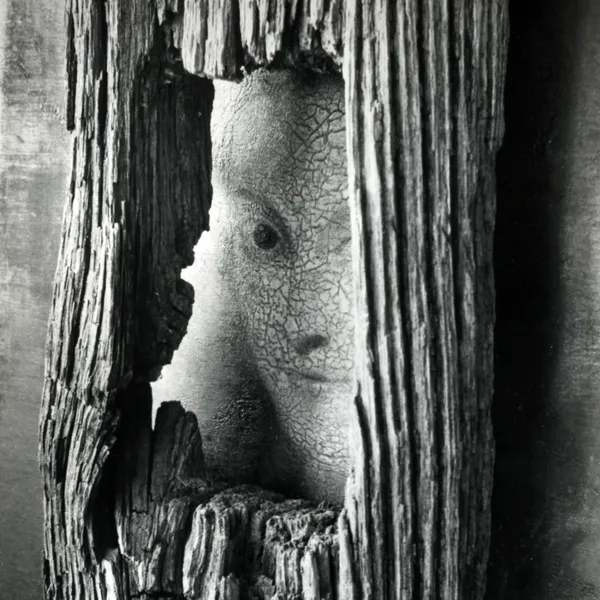
 André KertészDistortion #121 (Crop), 1933Gelatin silver print, printed c. 1970s9 3/8 x 6 3/8 in (23.8 x 16.2 cm)
-
André KertészDistortion #91, 1933Gelatin silver print, printed c. 1970s10 x 8 in (25.4 x 20.32 cm)

-
André Kertész, M. C. Escher: Between Order and Chaos | Bruce Silverstein
Musée Magazine, March 19, 2026 -
Exhibition at Bruce Silverstein Gallery unites André Kertész and M. C. Escher
Art Daily, March 5, 2026 -
Between order and chaos: André Kertész and M. C. Escher
Meer, March 4, 2026 -
André Kertész and M.C. Escher Morphed the Mundane Into the Sublime
R.C. Baker, The Village Voice, February 27, 2026 -
Brilliant Things to Do This February
Daisy Woodward, AnOther Magazine, February 4, 2026 -
Master Drawings New York: A Starter’s Guide
Michael Wolf, B Scene Zine, January 29, 2026 -
Between Order and Chaos: André Kertész & M. C. Escher
Alexa Wang, FLUX, January 22, 2026 -
André Kertész and M. C. Escher: Between Order and Chaos
Mutual Art, January 22, 2026 -
Bruce Silverstein Gallery : André Kertész & M. C. Escher : Between Order and Chaos
The Eye of Photography, January 16, 2026 -
André Kertész and M. C. Escher: Between Order and Chaos
exibart street, January 15, 2026 -
Brilliant Things to Do This August
AnOther Magazine Featuring 'In Sequence'Daisy Woodward, AnOther Magazine, August 4, 2025 -
In Sequence | Bruce Silverstein Gallery
Amy Wei , Musee Magazine, June 23, 2025 -
Photographer as Sculptor, Sculptor as Photographer
Rosario Ana Vizoli, Meer, June 10, 2025 -
Photographer as Sculptor, Sculptor as Photographer @ Bruce Silverstein
Just the FactsLoring Knoblauch , Collector Daily , May 30, 2025 -
Photographer as Sculptor, Sculptor as Photographer
ReviewGreer Valaquenta, Musée Magazine, May 1, 2025 -
Exhibition at Bruce Silverstein's new space explores the fascinating intersection on photography and sculpture
Art Daily, April 10, 2025 -
Bruce Silverstein Gallery: Photographer as Sculptor, Sculptor as Photographer
The Eye of Photography, April 7, 2025 -
BRILLIANT THINGS TO DO THIS JUNE
Daisy Woodward, Another Magazine, June 2, 2023 -
ANDRÉ KERTÉSZ AND FREDERICK SOMMER AT THE NATIONAL GALLERY OF ART
the National Gallery of Art, May 3, 2023 -
EXHIBITION REVIEW: REWIND: 20TH ANNIVERSARY SHOW
Emily Capone, Musée: Vanguard of Photography Culture, January 10, 2022 -
ANDRE KERTESZ’S PHOTOS FROM HIS WINDOW
David Gonzalez , The New York Times, March 28, 2019 -
SHAPE OF LIGHT: 100 YEARS OF PHOTOGRAPHY AND ABSTRACT ART
Tate, April 30, 2018 -
MAN RAY FETCHES RECORD €2.6M DURING PARIS PHOTO WEEK
Anna Sansom, France 24, November 13, 2017 -
ANDRE KERTESZ: "MIRRORING LIFE" AT FOAM
Foam, September 17, 2017 -
EXPLORING PHOTOGRAPHY'S ELECTRIC RELATIONSHIP
Michael Bucher, Time Magazine, July 8, 2016 -
ANDRÉ KERTÉSZ AT THE GETTY
The Getty, April 15, 2015 -
ANDRÉ KERTÉSZ AT THE MUSEUM OF MODERN ART: Modern Photographs from the Thomas Walther Collection
MoMA, December 13, 2014 -
CONSTANTIN BRANCUSI AND ANDRÉ KERTÉSZ AT THE MUSEUM OF FINE ARTS, BOSTON: Photo Eye: Avant-Garde Photography in Europe
Museum of Fine Arts Boston, March 15, 2014 -
ANDRÉ KERTÉSZ AND FREDERICK SOMMER AT BOWDOIN COLLEGE OF ART Under the Surface: Surrealist Photography
Bowdoin College Museum of Art, February 27, 2014 -
ANDRÉ KERTÉSZ AND LISETTE MODEL AT THE ISRAEL MUSEUM: Displaced Visions Emigré Photographers of the 20th Century
The Israel Museum, May 13, 2013 -
ANDRÉ KERTÉSZ AND AARON SISKIND AT THE NASHER MUSEUM OF ART
Nasher Museum, February 14, 2013




-
Between Order and Chaos: André Kertész and M. C. Escher
22 Jan - 4 Apr 2026 Gallery ExhibitionsBruce Silverstein Gallery is pleased to announce Between Order and Chaos: André Kertész and M. C. Escher , an exhibition that brings together two extraordinarily influential artists who each uniquely...Read more -
In Sequence
26 Jun - 29 Aug 2025 Gallery ExhibitionsBruce Silverstein Gallery is pleased to present In Sequence , a group exhibition that brings together the works of Adger Cowans, Elger Esser, Todd Hido, Dakota Mace, Barbara Morgan, Ed...Read more -
Photographer as Sculptor, Sculptor as Photographer
10 Apr - 14 Jun 2025 Gallery ExhibitionsBruce Silverstein Gallery is pleased to present Photographer as Sculptor, Sculptor as Photographer , the inaugural exhibition of its new gallery space. This exhibition brings together sculptures and photographs by...Read more -
Summer Glow
11 Jul - 7 Sep 2024In photography, light is the medium’s essence, shaping each photograph’s composition, mood, texture, and depth. During the long days of summer, light evolves from the soft, diffused glow of the...Read more -
An Outsider's Eye
Discoveries from Bruce Silverstein Gallery, Curated by Frank Maresca 18 Apr - 18 May 2024 Outside ExhibitionsAn Outsider's Eye features more than 20 artists, including Karl Blossfeldt, Edward Weston, Man Ray, André Kertész, Dorothea Lange, Paul Outerbridge, Lisette Model, Walker Evans, Aaron Siskind, Bill Cunningham, and...Read more -
The Visual Language of Modernity
The Early Photographs of André Kertész 25 May - 5 Aug 2023 Gallery ExhibitionsBruce Silverstein Gallery proudly presents The Visual Language of Modernity: The Early Photographs of André Kertész . This exhibition showcases over fifty original prints of exceptional quality, each taken between...Read more -
20th Anniversary Exhibition
REWIND 16 Dec 2021 - 19 Feb 2022 Gallery ExhibitionsBruce Silverstein Gallery is pleased to announce REWIND , a celebration of our 20th anniversary. Featuring works selected from over one hundred exhibitions, REWIND is an opportunity to revisit the...Read more -
André Kertész
Window Views 28 Mar - 4 May 2019 Gallery ExhibitionsFollowing his move in 1952 to a 12th story apartment overlooking Washington Square Park, the 56-year-old Hungarian emigrant André Kertész would begin a series of modernist masterworks shot from his...Read more -
Inscribed
10 Dec 2015 - 23 Jan 2016 Gallery ExhibitionsBruce Silverstein / 20 is pleased to present Inscribed .Read more -
de-FORMATIONS
A group show featuring Andre Kertesz’s Distortions series 26 Feb - 18 Apr 2015 Gallery ExhibitionsIn 1933 André Kertész photographed two nude models in a carnival mirror as an assignment for the risqué publication Le Sourire. For a magazine often illustrated with erotic drawings, Kertész’s...Read more -
Night
Brassaï, Ilse Bing, Robert Doisneau and André Kertész 7 Apr - 4 Jun 2011 Gallery ExhibitionsBruce Silverstein Gallery is pleased to present: NIGHT , an exhibition of the work of Brassaï, Ilse Bing, Robert Doisneau and André Kertész.Read more -
DISCOVERIES
A special selection of extraordinary photographs from the gallery's private inventory 8 Jul - 6 Aug 2010 Gallery ExhibitionsBruce Silverstein Gallery is pleased to announce DISCOVERIES, an exhibition featuring an eclectic selection of rare and noteworthy works by 35 known and lesser-known artists from the 20 th century.Read more -
Discoveries
A special selection of extraordinary photographs from the gallery's private inventory 16 Jun - 8 Aug 2009 Gallery ExhibitionsBruce Silverstein Gallery is pleased to announce DISCOVERIES , an exhibition featuring an eclectic selection of rare and noteworthy works by lesser-known artists from the 20th century.Read more -
André Kertész
In the Depths of Winter 10 Mar - 25 Apr 2009 Gallery ExhibitionsRead more -
André Kertész
The Polaroids 18 Oct - 24 Nov 2007 Gallery ExhibitionsBruce Silverstein Gallery is pleased to announce André Kertész: The Polaroids , opening October 18, 2007. This is the first time the Hungarian-born artist’s final body of work has been...Read more -
André Kertész
The Early Years 15 Oct - 12 Nov 2005 Gallery ExhibitionsThis exhibition is the first solo show entirely dedicated to the artist's original Hungarian contact prints.Read more -
TOPOGRAPHICS
PHOTOGRAPHS FROM 1844 TO THE PRESENT 2 Oct - 13 Nov 2004 Gallery ExhibitionsRead more -
André Kertész
The New York Period 1936-1985 9 Jan - 15 Mar 2003 Gallery ExhibitionsRead more


-

Paris Photo 2026
11 - 15 Nov 2026Opening Wednesday, November 11, 2026 (by invitation only) Collectors Circle: 11 a.m. – 9 p.m. VIP: 2pm – 9pm Early Access Collectors Circle & VIP...Read more -

The Armory Show 2026
24 - 27 Sep 2026Booth 310 For hours and events visit The Armory ShowRead more -

AIPAD 2026
23 - 26 Apr 2026BOOTH B01 For hours and events, visit AIPAD . Thursday, 4pm - Chester Higgins will be in our booth to talk about his photography. Friday,...Read more -

Master Drawings New York 2026
30 Jan - 7 Feb 2026January 30 - February 7, 2026 | 11am - 6pm daily (Sunday February 1 , 2026 | 1 - 5PM)Read more -

Paris Photo 2025
12 - 16 Nov 2025Read more -

AIPAD 2025
23 - 27 Apr 2025Read more -

PARIS PHOTO 2023
5 Nov 2023 - 10 Feb 2024In a profound celebration of indigenous art and heritage, Bruce Silverstein Gallery is proud to present the works of two remarkable Native American artists, Sarah...Read more -

AIPAD 2023
30 Mar - 2 Apr 2023Read more -

AIPAD 2022
20 - 22 May 2022Read more -

THE ARMORY SHOW 2021
9 - 12 Sep 2021For The Armory Show 2021, Bruce Silverstein Gallery will present photographic and painted material focusing on New York from the 1960s to 1980s. The installation...Read more -

PARIS PHOTO 2019
7 - 10 Nov 2019Bruce Silverstein Gallery is pleased to present an exhibition that will include both iconic and lesser known photographs by some of the most important photographic...Read more -

AIPAD 2019
4 - 7 Apr 2019Read more -

THE ARMORY SHOW 2019
7 - 10 Mar 2019Bruce Silverstein is delighted to return to The Armory Show for the landmark art fair’s 25th Anniversary edition. Exemplifying the gallery’s commitment to presenting important...Read more -

PARIS PHOTO 2018
8 - 11 Nov 2018Recognized today as one of the most influential figures in modern photography, the Hungarian artist, designer and educator, György Kepes (1906-2001) was one of the...Read more -

FRIEZE MASTERS 2018
4 - 7 Oct 2018For Frieze Masters 2018, Bruce Silverstein Gallery would be pleased to present a selection of photographic masterpieces from the twentieth century created in the spirit...Read more -

AIPAD 2018
5 - 8 Apr 2018Read more -

THE ARMORY SHOW 2018
8 Mar 2018 - 11 Mar 2019Read more -

FRIEZE MASTERS 2017
5 - 8 Oct 2017For Frieze Masters 2017, Bruce Silverstein proposes a curated exhibition featuring significant photographic works by Constantin Brancusi, Alfred Leslie, Rene Magritte, Man Ray, Henry Moore,...Read more -

THE ARMORY SHOW 2017
2 - 5 Mar 2017For The Armory Show 2017 Bruce Silverstein Gallery will present an exhibition of paintings and photographs by Alfred Leslie, Paul Outerbridge, Eric Fischl, Todd Hido,...Read more -

PARIS PHOTO 2016
10 - 13 Nov 2016Bruce Silverstein Gallery is pleased to present at Paris Photo an exhibition inspired by one of the cornerstones of modern art, F. Holland Day’s seminal...Read more -

FRIEZE MASTERS 2016
6 - 9 Oct 2016Read more -

ART BASEL 2016
16 - 19 Jun 2016Read more -

AIPAD 2016
14 - 17 Apr 2016At the 2016 AIPAD Photography Show, Bruce Silverstein Gallery is proud to present Triumph of the Egg, featuring works of the same title by two...Read more -

THE ARMORY SHOW 2016
3 - 6 Mar 2016Read more -

PARIS PHOTO 2015
12 - 15 Nov 2015Read more -

ART BASEL 2015
16 - 21 Jun 2015Bruce Silverstein Gallery is pleased to present a selection of masterworks by André Kertész at Art Basel. The exhibition will serve as a retrospective of...Read more -

AIPAD 2015
16 - 19 Apr 2015Read more -

THE ARMORY SHOW 2015
5 - 8 Mar 2015For the Armory Show 2015 Bruce Silverstein Gallery proposes an exhibition with a theme and focus encapsulated by the title, 'Low Culture'. Spanning multiple decades,...Read more -

PARIS PHOTO 2014
13 - 16 Nov 2014Read more -

Frieze Masters 2014
15 - 19 Oct 2014For Frieze Masters 2014 Bruce Silverstein Gallery proposes a solo exhibition of the work of Keith Smith, an American artist active in the 1960s-80s. This...Read more -

FRIEZE MASTERS 2015
14 Oct 2014 - 18 Oct 2015The gallery is pleased to present a selection of modern photographic masterpieces at Frieze Masters in London from October 14 to 18, 2015. Artists include...Read more -

ART BASEL 2014
17 - 22 Jun 2014For Art Basel 45 Bruce Silverstein Gallery would be pleased to present an exhibition featuring rare, vintage prints by André Kertész created during his years...Read more -

AIPAD 2014
10 - 13 Apr 2014Read more -

ART BASEL MIAMI 2013
5 Dec 2013 - 8 Dec 2015For Art Basel Miami Beach, Bruce Silverstein Gallery proposes an exhibition of rare vintage prints from the Equivalents series 1925-34, created by the artist and...Read more -

PARIS PHOTO 2013
14 - 17 Nov 2013Read more -

FRIEZE MASTERS LONDON 2013
17 - 20 Oct 2013For Frieze Masters 2013 Bruce Silverstein Gallery proposes an exhibition of works by Aaron Siskind. Photographer and educator Aaron Siskind holds a preeminent place in...Read more -

ART BASEL 2013
13 - 16 Jun 2013For Art Basel 44 Bruce Silverstein Gallery would be pleased to present an exhibition of masterworks from the photographic medium. We will be featuring historically...Read more -

AIPAD 2013
4 - 7 Apr 2013Read more -

THE ARMORY SHOW 2013
7 - 10 Mar 2013Read more -

ART BASEL MIAMI 2012
6 - 9 Dec 2012For Art Basel Miami Beach, Bruce Silverstein Gallery proposes an exhibition of Constantin Brancusi’s photographs—rare vintage prints by the artist from the 1920s and 30s....Read more -

PARIS PHOTO 2012
15 - 18 Nov 2012Read more -

FRIEZE MASTERS 2012
11 - 14 Oct 2012For Frieze Masters 2012, Bruce Silverstein Gallery proposes an exhibition of photographic works by the renowned artists Constantin Brancusi, André Kertész and Aaron Siskind that...Read more -

AIPAD 2012
29 Mar - 1 Apr 2012Read more -

THE ARMORY SHOW 2012
8 - 11 Mar 2012Read more -

ART BASEL MIAMI 2011
1 - 4 Dec 2011For Art Basel Miami Beach, Bruce Silverstein Gallery proposes an exhibition exploring the notion of form as subject. We will display works by André Kertész,...Read more -

PARIS PHOTO 2011
10 - 13 Nov 2011For Paris Photo 2011, Bruce Silverstein Gallery proposes an exhibition exploring the notion of form as subject. We will display works by André Kertész, Edward...Read more -

ART BASEL 2011
15 - 19 Jun 2011For Art Basel 42, Bruce Silverstein Gallery would be pleased to present an exhibition of photographic works by the world famous sculptor Constantin Brancusi. The...Read more -

AIPAD 2011
17 - 20 Mar 2011Read more -

THE ARMORY SHOW 2011
2 - 6 Mar 2011Read more