
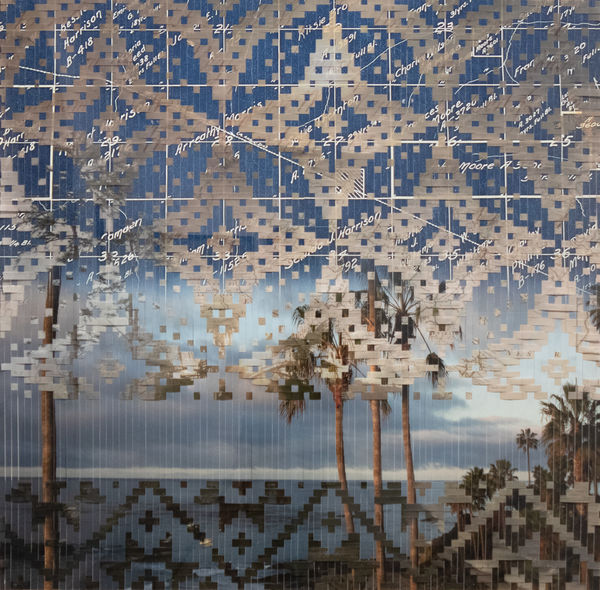
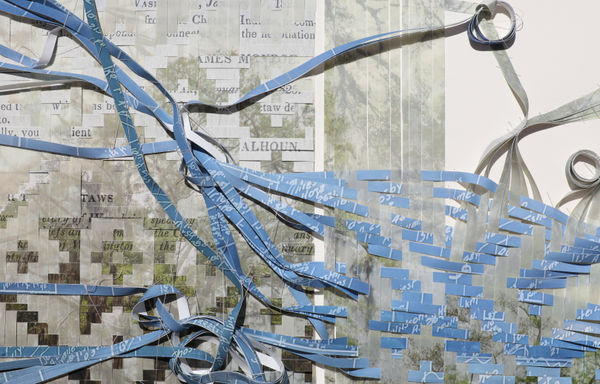
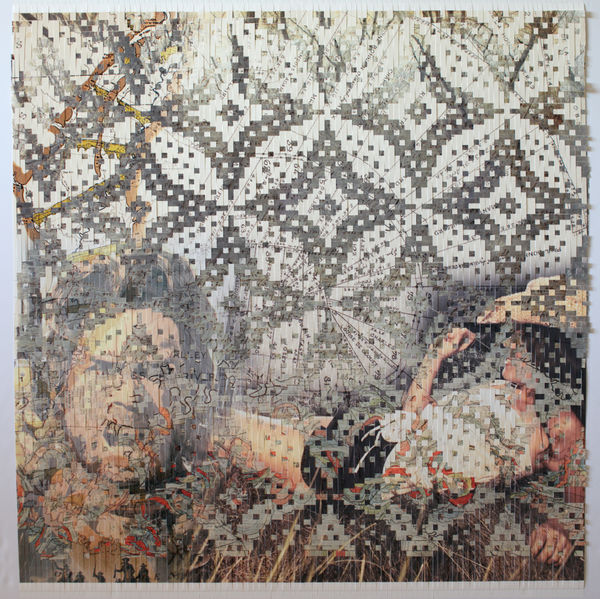
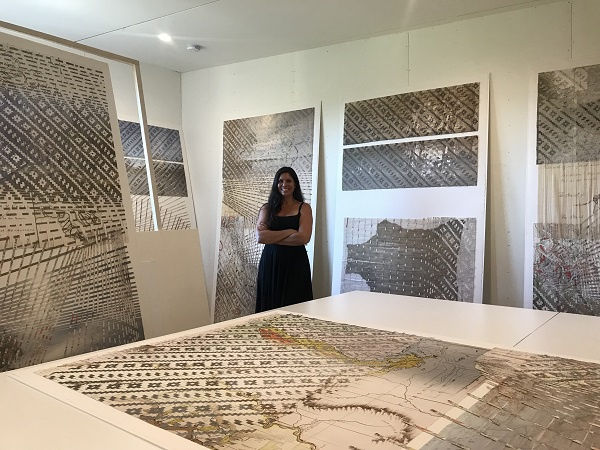
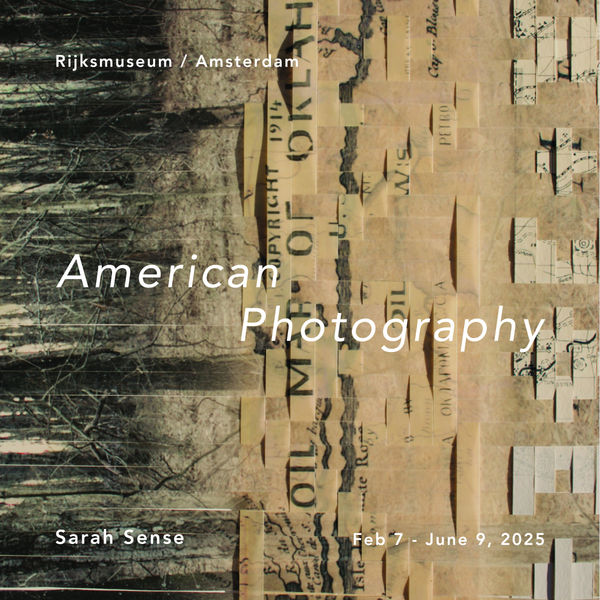
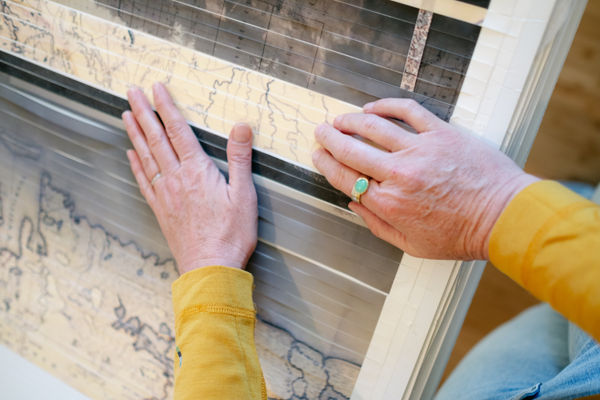
Sarah Sense (b. 1980) is a Chitimacha and Choctaw artist whose innovative photo-weavings bring ancestral basketry traditions into dialogue with photography, archival research, and the histories of Indigenous peoples. Combining her own landscape photographs with colonial maps, historical documents, Hollywood imagery, and family archives, Sense cuts photographic prints into strips and interlaces them using traditional Chitimacha and Choctaw basket patterns. Her practice challenges the conventional boundaries of photography, transforming the image into a physical structure in which material, form, and narrative become inseparable. Through this process, she explores the complex relationships between land, memory, cultural inheritance, and colonial history, reclaiming the authority of Indigenous perspectives within established historical narratives.
Born and raised in Sacramento, California, Sense developed an early appreciation for basketry through her grandmother. Her maternal grandmother is Choctaw from Oklahoma, and her maternal grandfather is Chitimacha from Louisiana. At eighteen, she was invited by the Chitimacha cultural department to research the tribe's historic baskets at the Southwest Museum of the American Indian, where she identified patterns no longer familiar to contemporary weavers on the reservation. She received a BFA in Studio Art from California State University, Chico, in 2003 and an MFA in Fine Art from Parsons the New School for Design in New York in 2005. During graduate school, with the blessing of the Chitimacha Tribal Chairman, she began developing her distinctive adaptation of traditional basket-weaving techniques, establishing the foundation for a practice that would unite contemporary image-making with ancestral knowledge.
In 2007, while serving as Director and Curator of the American Indian Community House in New York, Sense undertook the cataloguing of the organization's thirty-year history, an experience that inspired an extensive investigation into Indigenous art and cultural identity. Her research subsequently took her across the Americas, Southeast Asia, the Caribbean, the United Kingdom, and Europe. Between 2010 and 2012, she developed Weaving the Americas, a project that brought her from Canada to Chile, where she interviewed more than sixty Native artists. Living in Ireland from 2014 to 2016, she collaborated with her Choctaw grandmother on Grandmother's Stories, drawing upon family histories and personal recollections. These investigations informed Cowgirls and Indian Princesses (2018), a series that juxtaposes Hollywood posters, imagery of the American West, family photographs, and her grandmother's memoirs. By interweaving these disparate sources, Sense examines the construction of American mythology and the enduring influence of popular imagery on representations of Indigenous identity.
Beginning in 2019, as an Eccles Centre Visiting Fellow at the British Library, Sense conducted extensive research into colonial maps of North America, incorporating them into woven compositions alongside her own photographs of the American landscape. Through this process, she reclaims representations of ancestral territories, challenging the authority of cartographic systems historically employed to define ownership, impose boundaries, and facilitate dispossession. This research culminated in Power Lines, her first exhibition at Bruce Silverstein Gallery, which announced its exclusive representation of the artist in 2022. A work from the series, Language of America, entered the collection of the Victoria and Albert Museum in London. Her subsequent series, I Want to Hold You Longer (2024), brought colonial and allotment maps into dialogue with photographs of her ancestral homelands. Inspired in part by her encounters with historic Indigenous baskets in the collections of the Montclair Art Museum, Brooklyn Museum, and Worcester Art Museum, these works consider the intimate relationship between objects, their makers, and the transmission of cultural memory. Of particular significance was her experience handling six nesting Chitimacha baskets at Montclair, an encounter she likened to holding the hand of their original weaver.
In her 2026 series Land, Line, Blood, Memory, Sense extends these investigations through photo-weavings incorporating her photographs of American national parks, archival documents, historical imagery, and natural materials, including traditionally harvested rivercane. The rhythmic geometries of Chitimacha and Choctaw basketry intersect with the forms of trees, rivers, and landscapes, creating compositions that evoke both the physical character of the land and the histories embedded within it. By weaving together contemporary and historical imagery, Sense confronts the separation of Indigenous peoples from ancestral territories while affirming the persistence of cultural knowledge across generations. Throughout her practice, the act of weaving functions as both a formal intervention into photography and an expression of continuity, linking ancestral traditions to contemporary experience.
Sense's work has received increasing institutional recognition. Her large-scale woven compositions have been commissioned by Florida State University, the Amon Carter Museum of American Art, and the Choctaw Nation of Oklahoma. Her work was featured on the cover of In Our Hands: Native Photography, 1890 to Now and included in American Photography at the Rijksmuseum in Amsterdam in 2025. That same year, the National Gallery of Art in Washington, D.C., acquired her work for its permanent collection. Her photographs and photo-weavings are represented in prominent public and private collections internationally, including the National Gallery of Art; the Hood Museum of Art at Dartmouth College; the Montclair Art Museum, New Jersey; the Portland Art Museum, Oregon; the Victoria and Albert Museum, London; and the Rijksmuseum, Amsterdam. Sense has also taught at the Institute of American Indian Arts and New York University. Continuing to weave alongside her three children, she sustains the intergenerational transmission of the traditions that remain central to her artistic practice.




-

7 New York Exhibitions That Embody Indigenous Survivance
Rhea Nayyar, Hyperallergic, October 9, 2026 -
Sarah Sense: Land, Line, Blood, Memory
Mutual Art, September 17, 2026 -
Sarah Sense New Photo-Weavings
See Great Art, September 16, 2026 -
Bruce Silverstein Presents SARAH SENSE: LAND, LINE, BLOOD, MEMORY — Preview
Picture this Post, September 12, 2026 -
Bruce Silverstein Gallery : Sarah Sense : Land, Line, Blood, Memory
The Eye of Photography, September 9, 2026 -
Sarah Sense: Land, Line, Blood, Memory
All About Photo, September 1, 2026 -
Hyperallergic Fall 2026 New York Art Guide
Lisa Yin Zhang - Associate Editor, Hyperallergic, August 27, 2026 -
Sarah Sense: Land, Line, Blood, Memory - Artist Talk at Rhode Island College
Bannister Gallery, April 8, 2026 -
SARAH SENSE: A HISTORY OF NATURE AND INDIGENOUS HERITAGE AT BANNISTER
Suzanne Volmer, Artscope, March 8, 2026 -
Celebrating President’s Day with exhibit ‘Exploring America at 250’ at the Benton Museum
Sarah Sense FeatureJaylyn Davis, The Daily Campus, February 17, 2026 -
Along the Mississippi River, ‘Water | Craft’ Is a Confluence of Art, Culture, and Ecology
Sarah Sense at the Minnesota Marine Art MuseumKate Mothes, Colossal, February 11, 2026 -
The Weight of a Weave
In conversation with Sarah Sense about intimacy, erasure, and the stories held between image and fiber.Edgar Zhang, DART Magazine, February 6, 2026 -
A New Ringling Exhibit Features the Work of Nine Native American Women Artists
Sarasota Magazine, August 19, 2025 -
Brilliant Things to Do This August
AnOther Magazine Featuring 'In Sequence'Daisy Woodward, AnOther Magazine, August 4, 2025 -
In the Studio: With Sarah Sense
Montclair Art MuseumMontclair Art Museum, July 17, 2025 -
FRAMES Photography Podcast with Sarah Sense
FRAMES Magazine, July 15, 2025 -
In Sequence | Bruce Silverstein Gallery
Amy Wei , Musee Magazine, June 23, 2025 -
Indigenous Humor and Resistance Shines at the Photography Show
The most striking works on view at this New York fair channel political urgency into personal explorations, embracing sincere introspection.Daniela Mayer, Hyperallergic, April 25, 2025 -
This Poignant Photography Exhibition Weaves Together Indigenous History and Memory
Nilofer Khan, The Phoblographer, September 20, 2024 -
Bruce Silverstein Gallery to open their second solo exhibition of works by Sarah Sense
Art Daily, September 18, 2024 -
I want to hold you longer
Meer, September 18, 2024 -
NYC’s Longest-Running Photo Fair Is Back, and Packs a Punch
Even the world’s most proliferated images appear novel when they’re blown up on glossy paper at the Photography Show presented by AIPAD.Elaine Velie , Hyperallergic, April 26, 2024 -
Story Weaver
Sarah Sense Unveils the Rich Tapestry of her artistic journey, weaving Chitimacha and Choctaw heritage into contemporary masterpiecesLisa Robertson-Dziedzic, Casino Player, March 1, 2024 -
Hinushi
A Talk with Sarah Sense and MFA curator, Marina TyquiengcoThe Griffin Museum of Photography, November 28, 2023 -
"SPEAKING WITH LIGHT" EXHIBIT AT THE DENVER ART MUSEUM
Denver Art Museum, Denver Art Museum, February 28, 2023 -
FORBES: FIERCE, NOT AFRAID. INDIGENOUS PHOTOGRAPHY TAKES THE SPOTLIGHT
Chadd Scott, Forbes, December 13, 2022 -
EXHIBITION REVIEW: SARAH SENSE, POWER LINES
Diana McClure, Photograph Magazine, December 1, 2022 -
THE BRITISH LIBRARY: SARAH SENSE
British Library, October 27, 2022 -
ANDERMAN PHOTOGRAPHY LECTURE
Denver Museum of Art




-
Sarah Sense: Land, Line, Blood, Memory
17 Sep - 21 Nov 2026 Gallery ExhibitionsBruce Silverstein Gallery is pleased to announce Sarah Sense: Land, Line, Blood, Memory , the gallery’s third solo exhibition of work by Chitimacha/Choctaw artist Sarah Sense (b. 1980), who for...Read more -
Land, Line, Blood, Memory
Bannister Gallery | Rhode Island College 26 Mar - 24 Apr 2026 Outside ExhibitionsIn Land, Line, Blood, Memory , artist Sarah Sense (Chitimacha/Choctaw) combines her photographs of U.S. National Parks with old maps, images, and land records to explore place, history, and identity....Read more -
Paper Trails: Unfolding Indigenous Narratives
Featuring Sarah Sense 6 Feb - 12 Jul 2026 Outside ExhibitionsThe exhibition foregrounds urgent themes, including cultural preservation, hidden histories, and the enduring consequences of broken treaties—issues that are especially resonant as the United States approaches its 250th anniversary in...Read more -
Ancestral Edge: Abstraction and Symbolism in the Works of Nine Native American Women Artists
Ringling Museum 13 Sep 2025 - 12 Apr 2026 Outside ExhibitionsThis exhibition highlights contemporary Native design, craftwork, and art that employ the formal and aesthetic elements of abstraction as meaningful motifs and coded tools of Indigenous expression to communicate tribal...Read more -
In Sequence
26 Jun - 29 Aug 2025 Gallery ExhibitionsBruce Silverstein Gallery is pleased to present In Sequence , a group exhibition that brings together the works of Adger Cowans, Elger Esser, Todd Hido, Dakota Mace, Barbara Morgan, Ed...Read more -
Rijksmuseum
American Photography 7 Feb - 9 Jun 2025 Outside ExhibitionsAmerican Photography will give picture of the country through the eyes of American photographers, showing the country in all its complexity. The exhibition takes themes such as the American dream,...Read more -
Indigenous Identities: Here, Now & Always
Zimmerli Art Museum, Rutgers 1 Feb - 21 Dec 2025 Outside ExhibitionsThis exhibition, curated by the renowned artist Jaune Quick-to-See Smith (Citizen of the Confederated Salish and Kootenai Nation), provides a provocative survey of contemporary Native American art across media. A...Read more -
Sarah Sense
I Want to Hold You Longer 19 Sep - 23 Nov 2024 Gallery ExhibitionsBruce Silverstein Gallery is pleased to announce our second solo exhibition for Sarah Sense, a contemporary Indigenous artist, curator, and writer. Featuring over twenty unique, hand-woven, sculptural photographs, I Want...Read more -
[UN]MAPPING: Decolonial Cartographies of Place
Hood Museum at Dartmouth 8 Jun - 3 Nov 2024 Outside Exhibitions[Un]Mapping examines the legacies of mapmaking and invites viewers to think about alternatives for visualizing our relationships to place. This show focuses on the work of artists whose practices critique...Read more -
Reflecting Lenses
6 Mar - 1 Sep 2024 Outside ExhibitionsReflecting Lenses: Twenty Years of Photography at the Gorman Museum will be presented March 6 – September 1, 2024 . We are looking at hosting an event on Friday, April...Read more -
New Terrains
Contemporary Native American Art 5 - 23 Jan 2024 Outside ExhibitionsPhillipsX is pleased to present New Terrains , a watershed selling exhibition of important works of contemporary Native American art curated by Tony Abeyta, Bruce Hartman, and James Trotta-Bono. Exploring...Read more -
Entanglements
Center for Visual Art / MSU Denver 13 Jan - 25 Mar 2023 Outside ExhibitionsRead more -
Sarah Sense
Power Lines 22 Sep - 5 Nov 2022 Gallery ExhibitionsBruce Silverstein Gallery is pleased to announce the exclusive representation of contemporary Native artist, curator, writer, and activist, Sarah Sense, as well as the opening of her first New York...Read more






-

Paris Photo 2026
11 - 15 Nov 2026Opening Wednesday, November 11, 2026 (by invitation only) Collectors Circle: 11 a.m. – 9 p.m. VIP: 2pm – 9pm Early Access Collectors Circle & VIP...Read more -

The Armory Show 2026
24 - 27 Sep 2026Booth 310 For hours and events visit The Armory ShowRead more -

AIPAD 2026
23 - 26 Apr 2026BOOTH B01 For hours and events, visit AIPAD . Thursday, 4pm - Chester Higgins will be in our booth to talk about his photography. Friday,...Read more -

Paris Photo 2025
12 - 16 Nov 2025Read more -

AIPAD 2025
23 - 27 Apr 2025Read more -

PARIS PHOTO 2024
5 - 10 Nov 2024Read more -

THE ARMORY SHOW 2024
5 - 8 Sep 2024Bruce Silverstein Gallery is pleased to announce our participation in the 2024 edition of The Armory Show.Read more -

AIPAD 2024
25 - 28 Apr 2024For AIPAD 2024, Bruce Silverstein Gallery will present photographic and mixed media works with a predominant focus on the Native diaspora, featuring new works by...Read more -

PARIS PHOTO 2023
5 Nov 2023 - 10 Feb 2024In a profound celebration of indigenous art and heritage, Bruce Silverstein Gallery is proud to present the works of two remarkable Native American artists, Sarah...Read more -

THE ARMORY SHOW 2023
8 - 10 Sep 2023For The Armory Show 2023, Bruce Silverstein Gallery will present photographic and mixed media works with a predominant focus on the Native diaspora, featuring works...Read more -

AIPAD 2023
30 Mar - 2 Apr 2023Read more -

AIPAD 2022
20 - 22 May 2022Read more